Geopolymer Solution for Sulfuric Acid Corrosion at Wastewater Plants
WASTEWATER · MIC · CONCRETE · SULFURIC ACID ATTACK
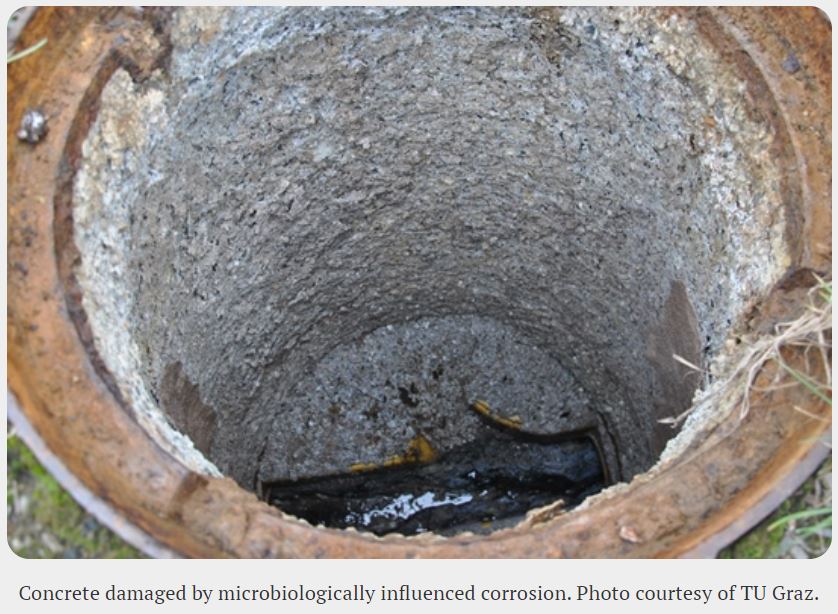
Concrete in wastewater systems can face an unusually aggressive form of deterioration: microorganisms help create sulfuric acid directly on the concrete surface.
Researchers at Graz University of Technology studied whether geopolymer-based concrete could offer better resistance to microbiologically influenced corrosion (MIC) in wastewater infrastructure than conventional ordinary Portland cement concrete.
HOW BIOGENIC SULFURIC ACID ATTACK DEVELOPS
Sulfates in Wastewater
↓
Hydrogen Sulfide Forms Under Anaerobic Conditions
↓
H₂S Enters the Sewer Headspace
↓
Surface Bacteria Oxidize H₂S
↓
Sulfuric Acid Attacks the Concrete
Why Wastewater Concrete Can Deteriorate So Quickly
In wastewater collection and treatment systems, sulfate-reducing microorganisms can generate hydrogen sulfide under oxygen-deficient conditions.
The hydrogen sulfide can leave the wastewater and enter the air space above it. On damp concrete surfaces, sulfur-oxidizing microorganisms can then convert the hydrogen sulfide into sulfuric acid.
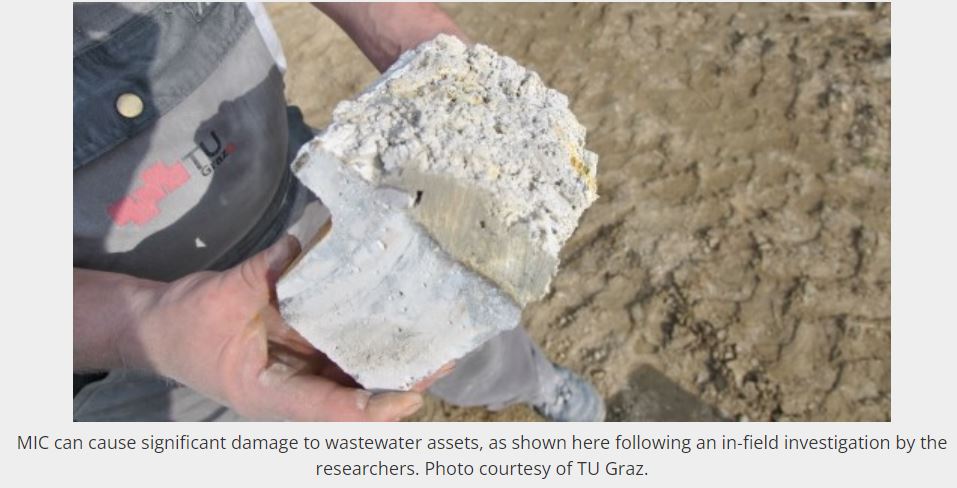
Biogenic sulfuric acid corrosion can develop when hydrogen sulfide is oxidized by microorganisms growing on moist concrete surfaces.
The researchers reported that heavily affected surfaces can develop very low pH conditions—below pH 2 in severe cases—along with biofilm growth and extensive formation of secondary minerals such as gypsum.
Together, acid dissolution, mineral alteration, moisture, and microbial activity can cause rapid loss of concrete material.
MIC IN CONCRETE IS A CHEMICAL + BIOLOGICAL PROBLEM
The microorganisms do not simply “eat” the concrete. Their metabolism helps create an aggressive chemical environment that attacks susceptible cementitious materials.
Why Ordinary Portland Cement Is Vulnerable to Acid Attack
Conventional Portland cement concrete hardens through hydration reactions that produce calcium-containing phases responsible for much of the material’s structure and binding capability.
Those calcium-rich hydration products can be vulnerable to strong acids. When sulfuric acid reaches the concrete surface, the acid can dissolve or chemically alter portions of the cement paste.
As deterioration progresses, the surface can soften, lose material, form expansive or weak reaction products, and become increasingly rough and damaged.
WHY OPC CAN STRUGGLE
Calcium-Rich Hydration Products
+
Strong Sulfuric Acid Exposure
↓
Dissolution & Material Loss
What Is Geopolymer Concrete?
Geopolymer and other alkali-activated concretes use a different binder chemistry from ordinary Portland cement.
Materials containing aluminosilicates—such as certain fly ashes, slags, or metakaolin—can be activated with alkaline solutions to form hardened binder systems based largely on aluminosilicate networks rather than conventional Portland cement hydration products.
The TU Graz researchers investigated whether this different chemistry could improve resistance to the aggressive acidic conditions found in some wastewater environments.
PORTLAND CEMENT
Hydration-based binder
Contains calcium-rich hydration phases that may be susceptible to dissolution under severe acid attack.
GEOPOLYMER
Aluminosilicate-based binder
Can form a more siliceous network that researchers found promising under acidic exposure.
Why Geopolymers May Resist Acid Differently
According to the researchers, acidic attack on some geopolymer systems can leave behind a silica-rich altered layer instead of simply dissolving the binder in the same manner as conventional cement paste.
That altered layer may remain relatively stable and can slow additional acid transport into the material. In that case, permeability through the acid-affected layer becomes an important factor controlling the rate of continuing attack.
The researchers also reported that aluminosilicate gel could remain after decalcification in some tested alkali-activated materials, helping preserve portions of the network structure even under low-pH exposure.
A DIFFERENT ACID-ATTACK RESPONSE
Acid Reaches the Surface
↓
Surface Chemistry Changes
↓
Silica-Rich Altered Layer Remains
↓
Further Acid Transport May Be Slowed
Laboratory Testing Showed Promising Acid Resistance
The researchers referenced laboratory studies using techniques such as X-ray diffraction, electron microscopy, and mechanical testing to examine the acid resistance of geopolymer materials.
In one reported example, a metakaolin-based material exposed to dilute hydrochloric acid for 28 days retained much of its network structure and binding capability despite chemical attack.
LAB ACID TEST ≠ WASTEWATER SERVICE LIFE
Resistance in a controlled laboratory acid exposure is useful evidence, but it does not automatically establish long-term performance in a wastewater structure exposed to microorganisms, moisture cycling, abrasion, reinforcement, construction variability, and changing chemistry.
Could Geopolymers Also Reduce Microbial Colonization?
The research team suggested that the altered chemistry of geopolymer surfaces may make bacterial settlement more difficult under some conditions.
They also proposed that antimicrobial cation additives might eventually provide another tool for limiting microbial colonization.
The researchers were clear, however, that additional research would be required before those approaches could be treated as established field solutions.
Why the Researchers Were Not Ready to Declare Victory
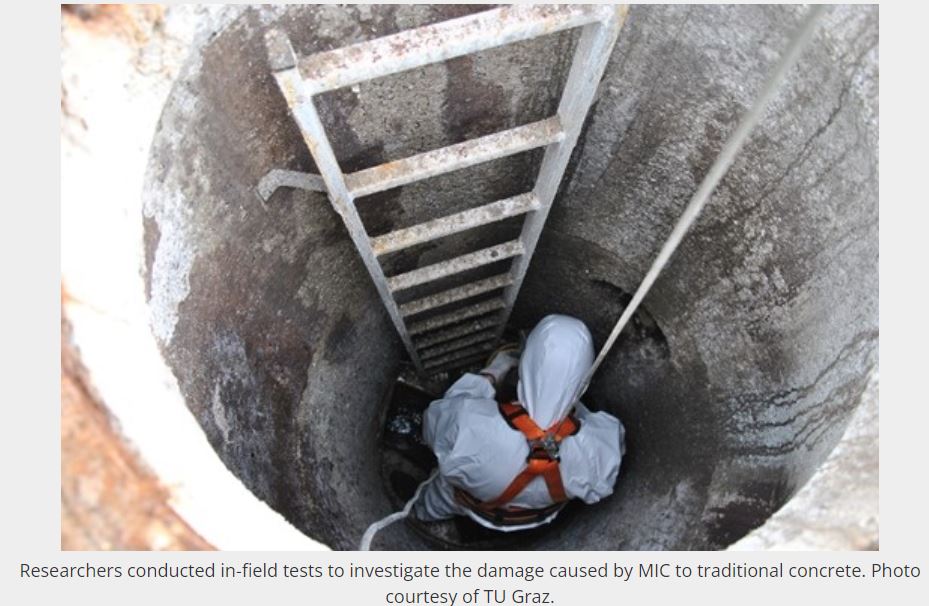
The researchers emphasized that additional field durability data and standardization would be needed before broad use of geopolymer concrete in wastewater infrastructure.
Despite the promising acid-resistance results, the researchers identified several unresolved issues that could affect practical field use.
OPEN QUESTIONS IDENTIFIED BY THE RESEARCHERS
- Limited long-term field durability data
- Lack of widespread standardization
- Variation in aluminum and silicon content between formulations
- Potential alkali leaching
- Efflorescence and surface salt formation
- Possible reduction of internal alkalinity
- Potential implications for embedded reinforcing steel
- Optimization of activator and water content
- Shrinkage behavior
- Creep behavior
Alkali Leaching Could Create a Different Durability Problem
One concern identified in the source was the ability of geopolymers to exchange ions with their environment.
Under MIC exposure, alkalis may leach from the geopolymer and contribute to formation of salts at the surface. This type of surface accumulation is commonly described as efflorescence.
The researchers also noted that losing alkalis could reduce internal pH. If the material contains conventional reinforcing steel, that raises an important question: whether long-term changes in alkalinity could eventually affect the passive condition that normally helps protect the reinforcement.
DURABILITY REQUIRES MORE THAN ACID RESISTANCE
Acid Resistance
+
Reinforcement Compatibility
+
Low Permeability
+
Dimensional Stability
↓
Reliable Long-Term Wastewater Performance
Why Lower Permeability Matters
The researchers also associated geopolymer materials with lower permeability than some conventional cement systems.
That can be important because aggressive species must move through the material before they can attack deeper regions. A denser microstructure can therefore reduce transport rates even when the surface is exposed to aggressive chemistry.
However, permeability depends strongly on the actual formulation, curing, water content, activator chemistry, workmanship, cracking, and service conditions. It should be measured or specified for the material being considered rather than assumed from the binder category alone.
Potential Sustainability Benefits
The research also highlighted the potential environmental appeal of some geopolymer systems. Certain formulations can incorporate industrial byproducts or alternative aluminosilicate feedstocks and may reduce reliance on conventional Portland cement.
The actual carbon footprint, however, depends on the full material formulation, activator production, transportation, curing, service life, maintenance requirements, and end-of-life assumptions. Sustainability therefore needs to be evaluated on a project-specific lifecycle basis.
What the Research Really Suggests
The 2018 research did not establish geopolymer concrete as a universal replacement for Portland cement in wastewater systems.
Instead, it identified a promising materials-development direction: use binder chemistry that is less vulnerable to biogenic sulfuric acid and investigate whether the resulting material can maintain both chemical resistance and structural durability over the required service life.
That requires balancing acid resistance against constructability, reinforcement performance, mechanical behavior, dimensional stability, field variability, standardization, and lifecycle cost.
QUESTIONS FOR ANY WASTEWATER CONCRETE SYSTEM
- What acid and microbial exposure will the material actually face?
- How permeable is the finished material?
- How will it perform under continuous moisture and wet-dry cycling?
- How will abrasion affect the exposed surface?
- What happens after the surface chemistry begins to change?
- How will embedded reinforcing steel remain protected?
- What are the shrinkage and creep characteristics?
- What field durability data support the expected service life?
- Are repair procedures and compatible materials available?
- What inspection and maintenance strategy will be used?
BOTTOM LINE
Geopolymer concrete may offer a different and potentially more acid-resistant chemistry for wastewater environments, but long-term durability depends on more than surviving sulfuric acid. Field performance, reinforcement protection, permeability, dimensional stability, and standardization all matter.
HISTORICAL RESEARCH NOTE
This article summarizes research reported in 2018. The work described geopolymer concrete as a promising research direction while also identifying major data and standardization gaps. Current material selection should rely on current field-performance evidence, project specifications, applicable standards, engineering requirements, and material-specific test data.
SOURCE
This article by Ben DuBose was originally published by Materials Performance Magazine. Republished with permission.
Original research source: Graz University of Technology (TU Graz).
WATER & WASTEWATER RESOURCES
Explore Corrosion Protection for Wastewater Infrastructure
AMPP resources cover wastewater corrosion, microbiologically influenced corrosion, coatings, concrete protection, material selection, inspection, and asset integrity.
EXPLORE MORE
Wastewater, MIC & Corrosion Resources
Water & Wastewater Corrosion Resources →
Corrosion Reference Library →
AMPP Education →
AMPP Standards →
Materials Performance Magazine →

Have photos or videos from the field? Submit them to AMPP →