UAVs Capable of Inspecting Ship Tanks for Signs of Corrosion
MARITIME INSPECTION · DRONES · COATINGS · CORROSION ASSESSMENT
Inspecting large ship tanks has traditionally required surveyors to get physically close to difficult-to-reach structural surfaces. An early DNV GL project demonstrated how drones could change that equation.
In a production survey reported in 2016, two DNV GL surveyors used an unmanned aerial vehicle (UAV) to assist with visual inspection of 14 cargo tanks aboard the chemical tanker MV Apollo. The approach reduced reliance on conventional staging and demonstrated how camera-equipped drones could help surveyors assess coating condition, corrosion, and structural damage in large enclosed spaces.
THE INSPECTION IDEA
Fly the Camera to the Structure
↓
Stream Close-Up Images to the Surveyor
↓
Identify Areas of Concern
↓
Send a Person Only Where Needed
Why Ship Tank Inspection Is Challenging
Cargo tanks and holds can contain large areas of structural steel, piping, brackets, access points, safety systems, coatings, and other components that need regular condition assessment.
The size and geometry of modern vessels can make close-up inspection difficult. Traditional access may involve scaffolding, staging, rafting, climbing, or other methods that require significant preparation before a surveyor can even reach the area being evaluated.
Those access methods can consume time and money and may also introduce additional hazards or the possibility of damaging existing protective coatings.
ACCESS CAN BE PART OF THE INSPECTION COST
For large tanks and holds, the effort required to reach a surface can sometimes rival the effort required to visually assess it. Remote inspection technologies aim to reduce that access burden where the inspection scope allows.
The MV Apollo Drone-Assisted Survey
The survey involved 14 cargo tanks aboard the MV Apollo, a chemical tanker managed by Carl Büttner Shipmanagement GmbH.
Two DNV GL surveyors completed the drone-assisted work in approximately two and a half days. According to the original report, eliminating extensive staging saved an estimated two to three days across the 14 tanks.
At the time, estimated staging-related savings were reported at approximately €14,000 to €28,000 in total, or roughly €1,000 to €2,000 per scaffold per tank.
14
Cargo tanks surveyed
The UAV supported visual assessment across multiple enclosed spaces.
2.5 DAYS
Reported survey time
The source reported meaningful schedule savings compared with staging-intensive access.
How the Two-Person Drone Team Worked
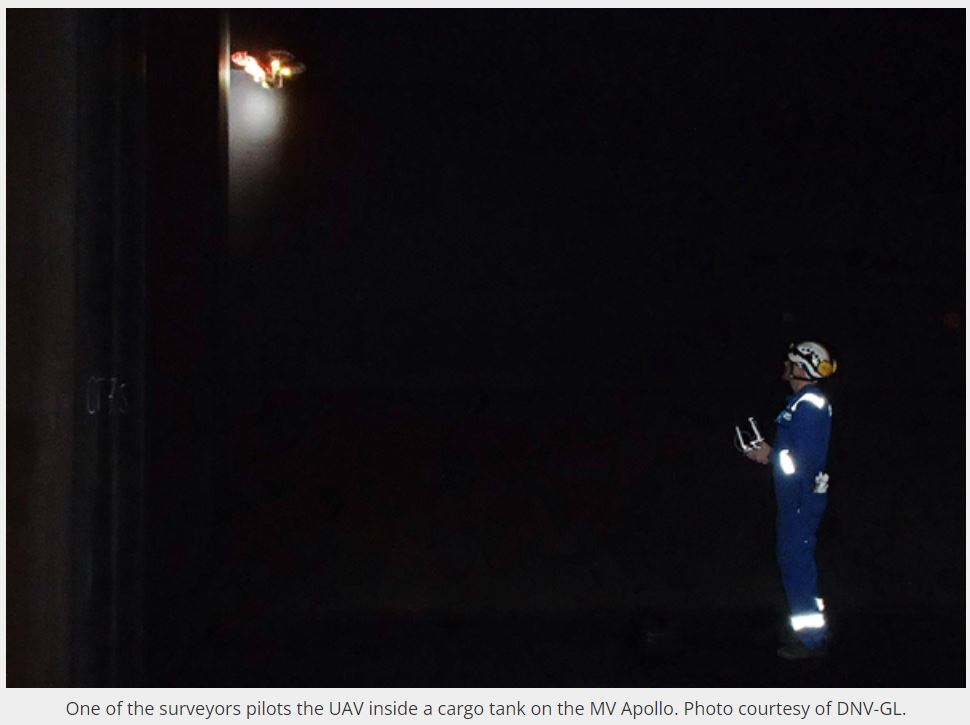
Drone-assisted inspection allowed surveyors to visually examine difficult-to-reach tank structure without building staging throughout the compartment.
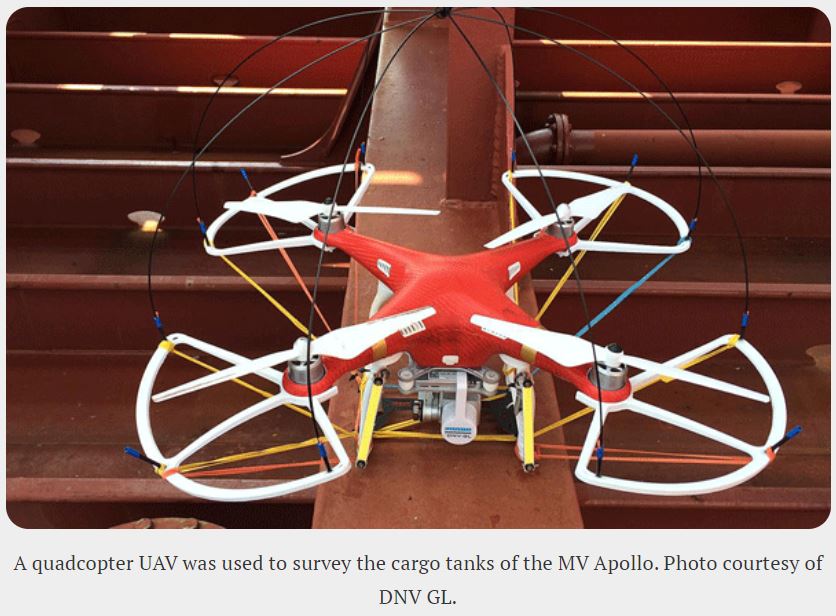
The surveyors used a UAV equipped with a DJI Phantom 3 camera. The camera streamed live video to a tablet during the inspection.
One surveyor concentrated on piloting the aircraft while the second focused on the real-time inspection imagery. This divided the responsibilities of safe flight and technical observation.
Additional lighting was mounted to the UAV, and protective guards were fitted around its propellers.
TWO PEOPLE, TWO JOBS
Pilot
+
Surveyor Watching the Inspection Feed
↓
Safer Flight + Focused Condition Assessment
Battery Life Was an Immediate Limitation
The additional lighting required inside the dark tank reduced the drone’s available flight time. The team therefore kept approximately six to seven charged batteries ready during the survey.
The UAV was landed approximately every 15 minutes for a battery change. That is a useful reminder that remote inspection does not eliminate logistics—it changes which logistics need to be managed.
REMOTE DOES NOT MEAN LOGISTICS-FREE
Lighting, battery endurance, communications, image quality, aircraft stability, safe launch and recovery, confined-space conditions, and access into the compartment all remain part of the inspection plan.
Could the Drone See Enough Detail?
According to DNV GL’s report at the time, imagery obtained during the survey provided detail comparable to a surveyor viewing the structure from approximately 1.5 meters away, consistent with the close-up visual requirements being applied to that survey.
The live video stream was also recorded, creating documentation that could be reviewed after the flight rather than relying only on observations made in real time.
For coating surveys, that documentation can be particularly valuable because images can help preserve evidence of rusting, coating breakdown, cracking, mechanical damage, staining, or other visible conditions for later comparison and reporting.
Reducing the Risk of Damage From Staging
One advantage highlighted by the vessel operator was avoiding potential coating damage caused by constructing and removing staging inside the cargo tanks.
That creates an interesting secondary benefit: the inspection access method itself is less likely to introduce mechanical contact with the coating system being inspected.
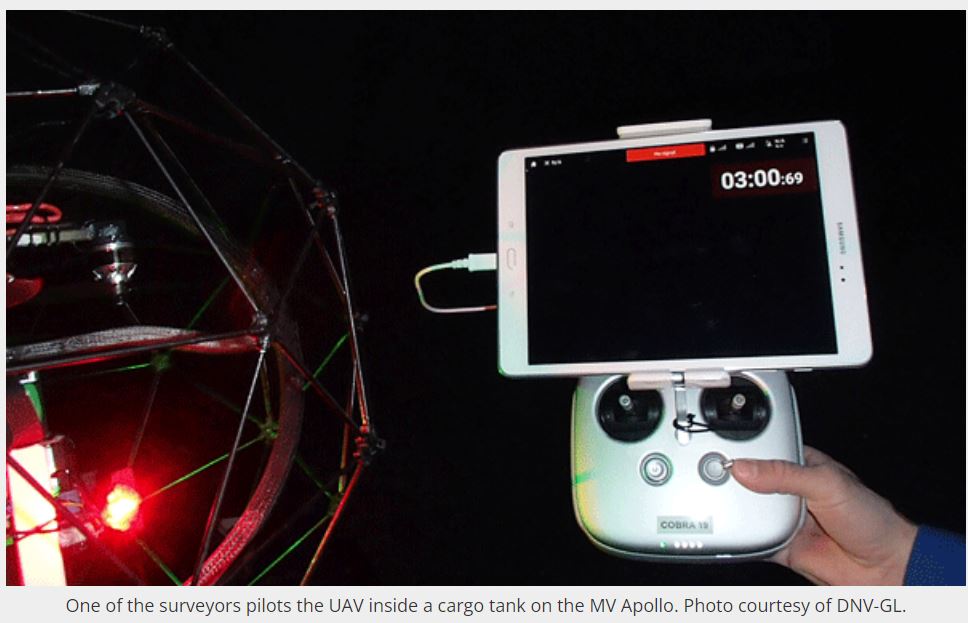
Early drone-assisted tank surveys used modified commercial UAV equipment equipped with additional lighting and protective hardware.
A Drone Did Not Eliminate the Need for Human Inspection
The UAV was primarily a visual-access tool. If the drone identified possible damage or an area that required more detailed evaluation, a conventional close-up inspection could still be necessary.
This distinction remains important for remote inspection generally: a camera can improve access and screening, but the inspection method must still be capable of answering the technical question being asked.
DRONES CHANGE ACCESS — NOT THE INSPECTION QUESTION
Visual screening can tell you where to look closer.
If a finding requires thickness measurement, adhesion testing, nondestructive testing, sampling, physical probing, or another hands-on examination, additional access and inspection methods may still be required.
Confined-Space and Atmospheric Safety Still Applied
The early UAV used in these surveys was not described as explosion-proof. Before operating it inside cargo tanks, the survey team conducted a risk assessment and confirmed that the tank was gas-free and certified for safe entry.
Remote technology therefore did not eliminate the need to control the hazards of the tank itself.
REMOTE INSPECTION STILL REQUIRES HAZARD CONTROL
Atmospheric hazards, ignition sources, confined-space requirements, vessel procedures, equipment ratings, access controls, communications, and emergency planning should all be addressed before remote inspection equipment is introduced into a tank or other enclosed space.
Why GPS Was a Problem Inside the Tank
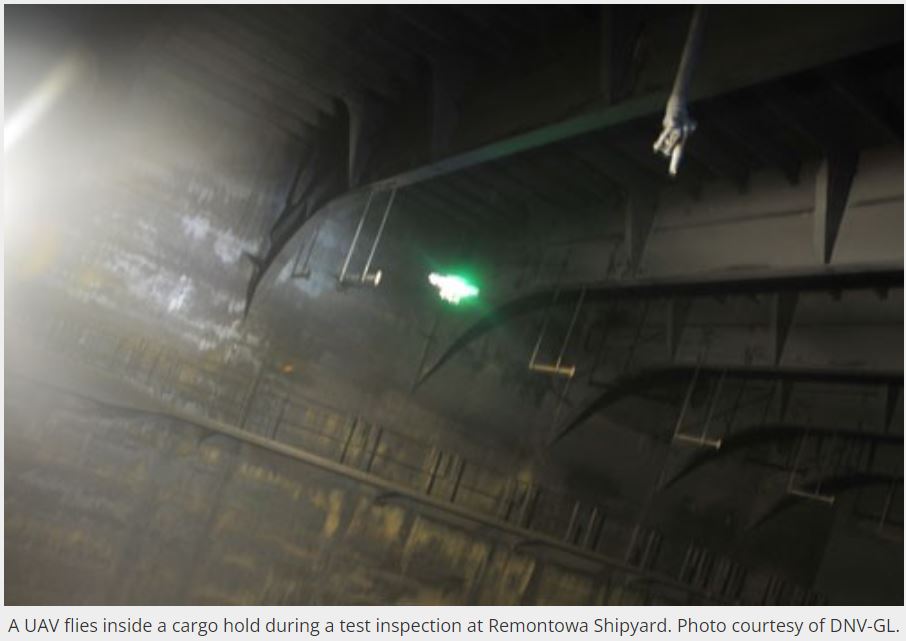
Enclosed steel tanks create a difficult navigation environment for UAVs because normal satellite-based positioning is unavailable.
One of the major technical limitations identified during the early work was navigation. Consumer drones commonly relied on GPS, magnetic compasses, and other sensors to maintain position and orientation.
GPS signals do not work normally inside enclosed ship tanks, making stable indoor flight considerably more difficult.
DNV GL experimented with other sensing approaches, including barometric positioning, but the airflow generated by the drone itself could interfere with pressure readings near overhead surfaces.
The Early Vision: Autonomous Tank Inspection
Even during these early trials, DNV GL was considering how drone inspection could eventually become more automated.
One concept involved loading a three-dimensional model of a vessel into the UAV system so that the aircraft could understand its location within the tank and follow a predefined inspection route.
The UAV could then stop at predetermined locations to capture images while the operator focused on the camera and lighting rather than manually controlling every part of the flight path.
The source also envisioned inspection imagery being automatically linked to locations within a 3D vessel model and eventually analyzed by software to help identify potential hull-condition concerns.
THE AUTOMATION VISION
3D Vessel Model
↓
Predefined Inspection Route
↓
Automated Image Capture
↓
Location-Tagged Inspection Records
↓
Software-Assisted Condition Analysis
From Cargo Tanks to Offshore Structures
The early program was not limited to a single chemical tanker. DNV GL had also tested UAV-assisted surveys on oil tankers, bulk carriers, and vessels at shipyards in Europe and China.
The organization was also exploring drone and remote-device inspection for topside and external structures on mobile offshore units.
This reflected a broader shift in inspection thinking: rather than assuming every visual assessment requires a person physically standing next to the surface, remote tools could first be used to screen large or difficult-to-access areas.
What the Case Study Still Teaches
Although the equipment described in this article belongs to an earlier generation of UAV technology, the project illustrates several enduring principles of remote inspection.
REMOTE INSPECTION TAKEAWAYS
- Use remote tools where they can reduce unnecessary exposure and access work.
- Define what visual detail the inspection actually requires.
- Separate aircraft operation from technical condition assessment when practical.
- Plan lighting and battery management for enclosed spaces.
- Account for GPS-denied navigation inside tanks and other structures.
- Preserve imagery for later documentation and comparison.
- Use remote screening to prioritize areas that need hands-on inspection.
- Do not assume a drone removes confined-space, atmospheric, or ignition hazards.
- Match the technology to the inspection objective—not the other way around.
BOTTOM LINE
Drones can reduce the need to put people and staging into difficult-to-access spaces, but their greatest value comes from combining safer access with useful inspection data—and knowing when a human still needs to take a closer look.
HISTORICAL TECHNOLOGY NOTE
This case study describes UAV technology and classification-society practices reported in the 2015–2016 period. Drone hardware, indoor positioning, autonomy, equipment certification, survey rules, remote-inspection procedures, and regulatory requirements may have changed substantially. Current inspection work should follow current vessel procedures, classification requirements, applicable regulations, equipment ratings, and qualified inspection guidance.
SOURCE
This article by Kathy Riggs Larsen was originally published by Materials Performance Magazine. Photos courtesy of DNV GL.
Original source information: DNV GL–Maritime. Republished with permission.
MARITIME CORROSION RESOURCES
Explore Inspection and Corrosion Control for Marine Assets
AMPP resources cover marine corrosion, protective coatings, inspection, ship structures, asset integrity, and corrosion-control technologies.
EXPLORE MORE
Maritime Inspection & Corrosion Resources
Maritime Corrosion Resources →
Corrosion Reference Library →
AMPP Education →
AMPP Standards →
Materials Performance Magazine →

Have photos or videos from the field? Submit them to AMPP →