Corrosion Basics – Water Constituents
WATER CHEMISTRY · CORROSION BASICS · INDUSTRIAL WATER · SCALE
Water is rarely just H₂O. Dissolved gases, salts, minerals, organic matter, microorganisms, temperature, and pH can all change the way a metal behaves in service.
For corrosion professionals, understanding water chemistry is often essential because even relatively small concentrations of certain constituents can influence corrosion rate, localized attack, deposit formation, scale, heat transfer, and materials compatibility.
WATER CHEMISTRY SHAPES THE CORROSION ENVIRONMENT
Dissolved Gases
+
Minerals & Dissolved Salts
+
pH & Temperature
+
Organics & Microorganisms
↓
Actual Corrosion & Scaling Behavior
What’s Actually in Water?
The concentration of individual substances in water may be relatively small, but the significance of those substances depends heavily on the application.
A constituent that is acceptable in a municipal water supply may be unacceptable in a high-pressure boiler, process-water system, cooling circuit, or another application where very small concentrations can affect corrosion, deposition, heat transfer, or equipment performance.
The original corrosion reference groups important water constituents into four broad categories.
DISSOLVED GASES
Oxygen, nitrogen, carbon dioxide, ammonia, hydrogen sulfide, and other gases that may dissolve into the water.
MINERAL CONSTITUENTS
Calcium, magnesium, chlorides, sulfates, bicarbonates, nitrates, sodium salts, silica, and trace metals.
ORGANIC MATTER
Natural organic matter, oils, agricultural or industrial wastes, detergents, and other carbon-containing materials.
MICROBIOLOGICAL FORMS
Algae, slime-forming organisms, bacteria, and other microorganisms capable of changing local environmental conditions.
Why Dissolved Oxygen Matters So Much
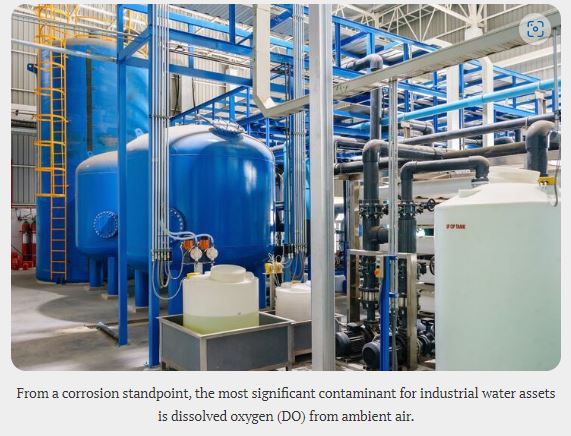
From a corrosion standpoint, dissolved oxygen is often one of the most important constituents in water.
In many aqueous corrosion systems, oxygen participates in the cathodic reaction. As oxygen is consumed at cathodic areas, the electrochemical corrosion process can continue as long as the necessary reactants and conductive pathways remain available.
This is one reason dissolved-oxygen control can be important in hot-water systems, boilers, and other closed industrial systems where oxygen-assisted corrosion may otherwise become severe.
OXYGEN CAN HELP SUSTAIN THE CORROSION CELL
Metal Dissolves at Anodic Areas
↓
Electrons Flow Through the Metal
↓
Oxygen Participates at Cathodic Areas
↓
Corrosion Can Continue
Dissolved Oxygen Is Not the Whole Story
The effect of oxygen depends on the complete system. pH, temperature, flow, alloy composition, deposits, chlorides, microbial activity, scale formation, and inhibitors can all change the observed corrosion rate.
Local differences in oxygen concentration can also create differential-aeration cells, where areas exposed to less oxygen become anodic relative to more highly aerated regions and experience localized attack.
A SINGLE WATER-QUALITY NUMBER RARELY EXPLAINS CORROSION
Dissolved oxygen may be important, but interpreting corrosion behavior requires looking at the chemistry, metallurgy, temperature, flow, deposits, treatment program, and operating conditions together.
The Role of pH
pH is another major variable because it influences electrochemical reactions, solubility, passive-film stability, mineral precipitation, and the behavior of many dissolved species.
The original reference notes that many natural waters fall within a moderately acidic to moderately alkaline range. Within that range, the corrosion behavior of steel and other metals can change substantially as oxygen concentration, alkalinity, scale formation, and other factors change.
At sufficiently low pH, acid-driven corrosion can become dominant. At higher pH values, some metals may develop more protective oxide or hydroxide films, although the effect is material- and environment-specific.
pH CAN INFLUENCE
- Passive-film stability
- Acid corrosion reactions
- Metal-ion solubility
- Scale precipitation
- Carbonate chemistry
- Microbial activity
- Corrosion-product stability
- Inhibitor performance
Why Copper Can Create Problems for Other Metals
Copper chemistry provides a useful example of why water constituents must be considered as part of a system rather than one material at a time.
Under some water conditions, copper can dissolve into the water as ionic species. Those dissolved copper species can then travel downstream and deposit on more active metals such as aluminum or zinc-coated surfaces.
Once deposited, the copper can create small galvanic sites and promote severe localized attack of the more active substrate.
METALS CAN INTERACT THROUGH THE WATER
Copper Dissolves Upstream
↓
Copper Ions Travel With the Water
↓
Copper Deposits on a More Active Metal
↓
Localized Galvanic Attack Can Develop
Chlorides Can Increase Corrosion Risk
Chloride ions are important in many corrosion problems because they can increase water conductivity and destabilize protective films on susceptible metals.
For passive alloys, chlorides can be particularly important in localized corrosion mechanisms such as pitting or crevice corrosion when other environmental conditions also favor attack.
The significance of a given chloride concentration depends on the alloy, pH, temperature, oxygen content, flow, deposits, other ions, and the specific system.
Carbon Dioxide Changes Water Chemistry
Dissolved carbon dioxide can react with water to affect carbonate chemistry and pH. Depending on the system, this can influence both corrosion and scale formation.
In industrial water systems, carbon dioxide can therefore be important not only as a dissolved gas but also because it changes the chemical environment surrounding the metal.
Sulfides and Ammonia Can Matter Too
Industrial and natural waters may contain sulfide species or ammonia, both of which can affect corrosion behavior depending on the materials present and the surrounding chemistry.
Their importance is highly material-specific, which is why water analyses used for corrosion assessment should be interpreted in the context of the actual metallurgy and operating environment.
Temperature Usually Speeds Chemical Reactions — But Water Systems Are Complicated
As with many chemical processes, increasing temperature often increases reaction rates and can accelerate corrosion.
But temperature can also change gas solubility, scale precipitation, inhibitor performance, oxygen availability, microbial activity, and water chemistry.
That means the relationship between temperature and corrosion is not always a simple straight line in an operating system.
TEMPERATURE CHANGES MORE THAN REACTION SPEED
Hotter water can change dissolved-gas content, mineral solubility, scale behavior, microbial activity, treatment chemistry, and protective-film stability—all of which can affect the observed corrosion rate.
Scale Can Protect — or Create New Problems
Minerals dissolved in water can precipitate onto metal surfaces and form scale.
A thin, uniform, adherent deposit can sometimes reduce direct contact between the metal and the water and therefore provide a degree of protection.
But nonuniform scale can create differential conditions on the surface. Cracks, pores, deposits, and under-deposit environments can promote localized corrosion even while other areas appear protected.
Thick scale can also interfere with heat transfer, reduce flow area, increase pressure drop, and create operational problems independently of corrosion.
SCALE IS NOT AUTOMATICALLY GOOD OR BAD
Uniform, Stable Deposit
→
May Reduce General Attack
Porous, Cracked, or Uneven Deposit
→
May Promote Localized Attack
Water Hardness and Corrosion Are Not the Same Thing
Water hardness generally reflects dissolved calcium and magnesium concentrations. Hardness can influence scale formation, but it should not be used by itself as a direct measure of whether water is corrosive.
Two waters with similar hardness can behave very differently if their alkalinity, pH, chloride concentration, dissolved oxygen, temperature, flow, or other constituents differ.
Microorganisms Can Change Local Conditions
Water systems can also support bacteria, algae, biofilms, and other biological growth.
Microorganisms may create deposits, consume or produce chemical species, alter local pH, establish differential aeration, or contribute to microbiologically influenced corrosion.
Their influence is another reason bulk-water chemistry alone may not fully describe the environment directly at the metal surface.
Bulk Water and Surface Water Can Behave Differently
A laboratory water sample usually describes the bulk fluid. Corrosion, however, occurs at an interface.
Under deposits, inside crevices, within biofilms, or near heat-transfer surfaces, the chemistry immediately adjacent to the metal can differ substantially from the chemistry measured in a bottle taken elsewhere in the system.
Effective corrosion assessment therefore combines water analysis with knowledge of operating conditions and evidence from the asset itself.
READ THE WATER AND THE ASSET TOGETHER
Water Analysis
+
Materials of Construction
+
Flow, Temperature & Operation
+
Deposits, Scale & Biofilm
↓
Better Corrosion Interpretation
What to Look at in an Industrial Water Analysis
The exact analytical program depends on the system, but corrosion investigations may consider parameters such as:
- pH
- Dissolved oxygen
- Conductivity or total dissolved solids
- Chloride
- Sulfate
- Alkalinity
- Hardness
- Calcium and magnesium
- Iron and other dissolved metals
- Carbon dioxide or carbonate chemistry
- Sulfide species
- Ammonia
- Temperature
- Silica
- Organic contamination
- Microbiological activity where relevant
The most useful parameters are those connected to a specific corrosion mechanism or operating question. More data are not automatically better unless the results can be interpreted in the context of the system.
BOTTOM LINE
Water chemistry does not act on corrosion one constituent at a time. Dissolved gases, salts, pH, temperature, microorganisms, scale, flow, and the metal itself interact to create the actual corrosion environment.
TECHNICAL NOTE
Water-quality limits, corrosion indices, treatment targets, oxygen-control requirements, inhibitor concentrations, materials compatibility, and acceptable scaling conditions vary by system. Current project requirements, applicable standards, equipment guidance, and qualified corrosion or water-treatment expertise should govern operating decisions.
SOURCE
This article by Pierre R. Roberge was originally published by Materials Performance Magazine. Republished with permission.
The original article was adapted by Materials Performance Technical Editor Norm Moriber from Corrosion Basics—An Introduction, Second Edition, edited by Pierre R. Roberge (NACE International, 2006), pp. 514–516.
WATER & WASTEWATER RESOURCES
Explore Corrosion in Water Systems
AMPP resources cover water chemistry, corrosion mechanisms, coatings, materials selection, monitoring, inspection, and corrosion control for water and wastewater assets.
EXPLORE MORE
Water Chemistry & Corrosion Resources
Water & Wastewater Corrosion Resources →
Corrosion Reference Library →
AMPP Education →
AMPP Standards →
Materials Performance Magazine →

Have photos or videos from the field? Submit them to AMPP →