Bend Test of Concrete Power Poles
CONCRETE DURABILITY · STRUCTURAL TESTING
Bending tests can reveal how reinforced concrete poles respond to increasing mechanical loads by measuring cracking, displacement, elastic recovery, and ultimate strength. In this study, two poles with the same reinforcement design but different concrete mixes showed substantially different flexural performance.
The results illustrate an important durability principle: concrete that resists cracking and maintains structural performance under loading may also be better positioned to limit pathways that allow moisture and corrosive agents to reach embedded reinforcement.
ABOUT THIS STUDY
The testing described here followed an Iranian instruction for concrete power poles that the authors compared with CEB Standard 044-3. Load ratios and acceptance criteria presented in this article reflect the test procedure used in the study and should not be assumed to apply to every concrete pole design, jurisdiction, or specification.
AT A GLANCE
What the bending test evaluates
- Initial surface condition and pre-existing cracks or defects
- Displacement under increasing load
- Whether load and displacement remain approximately proportional
- Whether cracks close after load is reduced
- Permanent displacement after unloading
- Ultimate load before failure or loss of load-carrying response
IN THIS ARTICLE
Why bending performance matters · Test setup · Normal strength · Elastic behavior · Ultimate strength · Study results · Durability implications · Common questions
Why Does Bending Performance Matter in Reinforced Concrete Poles?
Reinforced concrete relies on two materials working together. The concrete carries substantial compressive stresses, while the reinforcement helps resist tensile stresses that develop as the member bends.
If the reinforcement arrangement, concrete quality, curing, and overall structural design perform as intended, the pole should exhibit predictable behavior as bending load increases.
CONCRETE
Compression & Crack Resistance
Concrete quality influences compressive performance, stiffness, cracking behavior, and the ability of the material to protect embedded reinforcement from environmental exposure.
REINFORCEMENT
Tension & Flexural Capacity
Steel reinforcement helps the concrete member carry tensile stresses and influences how it behaves as bending forces increase.
THE CORE IDEA
The test looks at more than the load required to break the pole.
Crack formation, load-displacement behavior, elastic recovery, and residual deformation all provide information about how the member responds before ultimate failure occurs.
How Was the Concrete Pole Bending Test Set Up?
The study used a test procedure similar to the bend test described in CEB Standard 044-3, with some differences specific to the Iranian concrete pole test referenced by the authors.
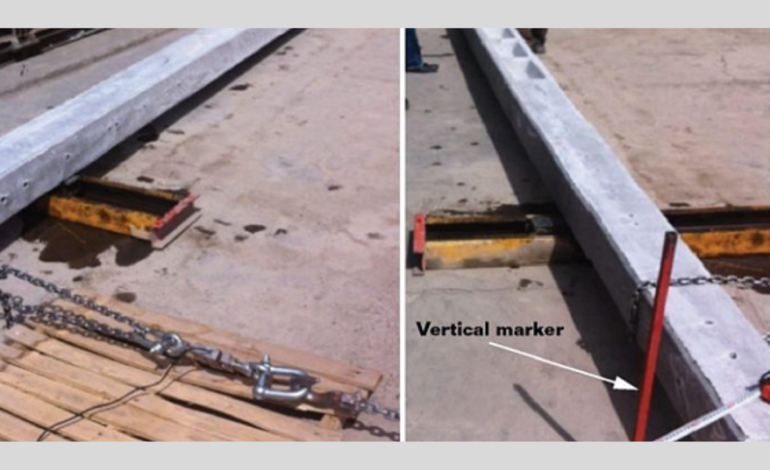
The portion of the pole intended to be placed underground—approximately 14% of its total length—was fixed between reinforced concrete supports. The H-section pole was positioned with its full web facing upward.
Bending force was applied near the opposite end using a pulling system, while rollers allowed lateral movement as the pole deflected. A dynamometer measured the applied force, and a stationary vertical marker provided a reference for measuring movement of the pole.
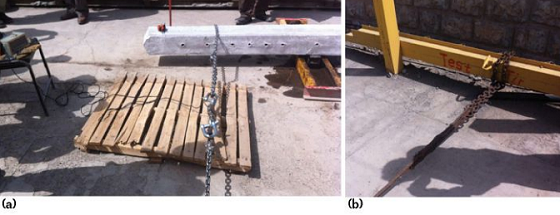
Figure 2. Test equipment used to measure and apply bending force to the concrete pole.
Three stages of bending behavior were evaluated
01
Normal Strength
Response at the pole’s designated normal bending load.
02
Elastic Behavior
How the pole behaves above its normal load and whether it recovers.
03
Ultimate Strength
Maximum load behavior as the pole approaches failure.
1. Evaluating Normal Bending Strength
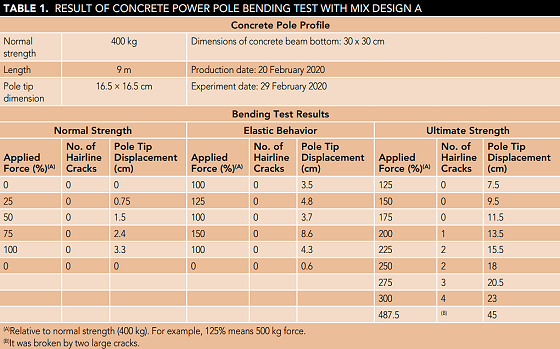
Before loading began, researchers documented cracks and other visible surface defects. The bending load was then increased gradually in four increments corresponding to 25%, 50%, 75%, and 100% of the pole’s designated normal strength.
At each stage, they recorded movement of the pole tip and any changes to the concrete surface. The load was then completely removed so residual displacement and cracking could be evaluated.
EXPECTED NORMAL-STRENGTH BEHAVIOR IN THIS TEST
- No significant cracking during the four loading steps
- Approximately linear relationship between applied force and pole-tip displacement
- Return close to the original position after unloading
- No significant residual cracking other than very small hairline cracks permitted by the test procedure
2. Evaluating Elastic Behavior
The procedure used in the study then tested how the pole behaved at loads above its designated normal strength. Loads were increased and reduced in stages, reaching 1.25 and then 1.50 times the normal bending load.
At each step, researchers recorded pole-tip displacement as well as the number, position, and persistence of any cracks.
LOAD SEQUENCE USED IN THE STUDY
Normal load
↓
1.25 × normal load
↓
Return to normal load
↓
1.50 × normal load
↓
Return to normal load
↓
Complete unloading
Under the acceptance procedure cited by the authors, a pole that survived this phase was evaluated for crack closure, proportional load-displacement behavior, and limited permanent displacement after the load was removed.
WHAT ELASTIC RECOVERY TELLS US
Deflection under load is not necessarily failure.
The important question is how the structural member responds as the load changes—and how much deformation and cracking remain after the force is reduced or removed.
3. Measuring Ultimate Bending Strength
The final stage examined how much bending load the pole could sustain before reaching its ultimate response.
Beginning at 125% of normal strength, the load was increased in increments equal to 25% of normal strength. Crack locations and pole-tip displacement were recorded at each step.
The researchers identified ultimate bending strength when displacement continued without an additional increase in applied force.
TEST-SPECIFIC ACCEPTANCE CRITERIA
For the pole category evaluated in this study, the cited Iranian test procedure required an ultimate strength of at least three times normal strength for poles with normal strength up to 400 kg. Other designs and standards may use different requirements.
What Happened When the Two Concrete Poles Were Tested?
The study compared two power poles designated Pole A and Pole B. Both used the same reinforcement design, but the concrete mix designs were different.
After eight hours of moist curing, the average compressive strengths reported for the two mixes were:
MIX A
517.5 kg/cm²
Reported average compressive strength after 8 hours of moist curing
MIX B
295 kg/cm²
Reported average compressive strength after 8 hours of moist curing
POLE A
Ultimate load: 1,950 kg
Pole A reached a reported ultimate load equal to 487.5% of its normal strength, exceeding the three-times-normal-strength acceptance criterion used for this test. The authors considered its bending performance suitable.
POLE B
Ultimate load: 950 kg
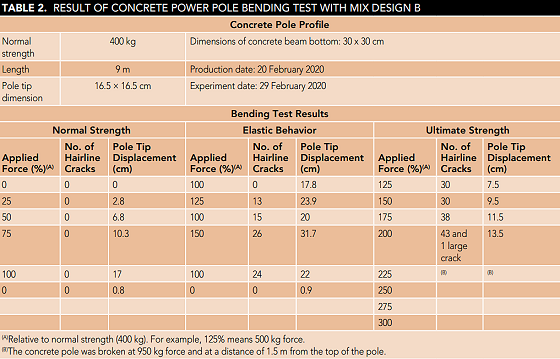
Pole B developed only limited visible cracking during the earlier loading stages, but it retained 0.8 cm of displacement after the normal load was removed.
Its ultimate load of 950 kg was below the 1,200 kg value required to reach three times its 400 kg normal strength under the cited procedure. Pole B therefore did not meet the study’s bending-test acceptance criterion.
SAME REINFORCEMENT · DIFFERENT CONCRETE
The concrete mix changed the structural response.
Because the reinforcement design was held constant, the comparison illustrates how concrete mix properties can materially influence cracking, stiffness, load capacity, and overall flexural behavior.
What Does Bending Performance Tell Us About Concrete Durability?
Mechanical loading and environmental durability are related because cracking can provide pathways for water, chlorides, carbon dioxide, and other aggressive agents to move more readily toward embedded reinforcement.
A dense, appropriately proportioned and cured concrete mix can help limit permeability while also contributing to the mechanical properties needed to resist cracking under service loads.
IMPORTANT DISTINCTION
A successful bending test does not by itself establish long-term corrosion resistance or service life. Durability also depends on permeability, cover depth, curing, exposure environment, contaminants, cracking over time, reinforcement condition, workmanship, and other design and service factors.
WHY THIS RESEARCH MATTERS
Crack resistance connects structural performance with materials protection.
For reinforced concrete exposed outdoors, keeping the concrete intact is important not only for carrying mechanical loads but also for maintaining a protective barrier around the embedded steel.
Common Questions About Concrete Pole Bending Tests
Quick answers based on the testing approach described in this study.
What is a concrete pole bending test?
A bending test applies a controlled lateral load to a concrete pole while measuring displacement, cracking, recovery after unloading, and ultimate load behavior. The exact procedure and acceptance criteria depend on the governing standard or specification.
Why is pole-tip displacement measured?
Displacement shows how much the pole deflects as bending force increases. Comparing load with displacement can help evaluate stiffness, proportional behavior, elastic recovery, and permanent deformation.
Does cracking automatically mean a concrete pole has failed?
Not necessarily. Crack size, location, load level, whether the cracks close after unloading, residual deformation, and the governing acceptance criteria all matter. Some test procedures may permit limited fine cracking at particular stages.
What is ultimate bending strength?
Ultimate bending strength represents the maximum bending-load response identified under the applicable test procedure before the member reaches its limiting structural behavior or failure condition.
Does higher concrete compressive strength always mean greater durability?
No. Compressive strength can be an important indicator of concrete quality, but durability also depends on mix proportions, permeability, curing, cracking, cover depth, exposure environment, workmanship, and the deterioration mechanisms affecting the structure.
ORIGINAL RESEARCH & REFERENCES
1. Iran’s Instruction Standard for Testing Concrete Power Poles (Pre-Tensioned and Non-Pre-Stressed).
2. CEB Standard 044-3, Acceptance Test of Concrete Poles (Ceylon Electricity Board, 1966).
3. A. Aghajani and B. Aghajani, “Control of Environmental Degradation of Concrete Power Poles,” Materials Performance 57, no. 11 (2018).
This article, by Abbas Aghajani and Behnaz Aghajani, first appeared on MaterialsPerformance.com on October 30, 2020. Reprinted with permission.
EXPLORE MATERIALS PERFORMANCE
More Research on Concrete, Corrosion & Materials Performance
Explore technical articles covering reinforced concrete durability, corrosion mechanisms, structural materials, testing, coatings, and asset protection.
EXPLORE MORE
Concrete & Corrosion Resources
AMPP Corrosion Reference Library →
Materials Performance →
AMPP Education →

Have photos or videos from the field? Submit them to AMPP →