Estimating Corrosion of Embedded Steel Rebars in Bridge Structures
BRIDGE INFRASTRUCTURE · REBAR CORROSION
Researchers working with the Minnesota Department of Transportation developed prediction tools to estimate how much steel reinforcement may have been lost to corrosion inside concrete bridge elements. The approach uses visible cracking, exposure conditions, field data, and laboratory measurements to help engineers better estimate remaining rebar section and make more informed repair decisions.
The research addresses a persistent inspection challenge: corrosion can damage reinforcing steel long before the full extent of section loss is visible from the surface.
RESEARCH STORY
This article summarizes Minnesota Department of Transportation research on estimating reinforcing steel section loss in corrosion-damaged concrete bridge elements. The study was calibrated using Minnesota bridge conditions and specific concrete and cover assumptions, so the resulting models should not be treated as universal formulas for every structure.
AT A GLANCE
What the MnDOT research found
- Corrosion can reduce the cross-sectional area of reinforcing steel and contribute to cracking and spalling of surrounding concrete.
- Visual assessment alone can be unreliable, especially when bars are rust-covered or partly embedded.
- Crack width can provide useful information when reinforcement is still covered by concrete.
- 3-D scanning produced more accurate section-loss measurements in the laboratory.
- The prediction models still need more field data to reduce uncertainty and improve accuracy.
IN THIS ARTICLE
Why rebar corrosion matters · Inspection challenge · Project goals · Two prediction models · Field & laboratory testing · Key findings · What’s next · Common questions
Why Does Rebar Corrosion Matter in Concrete Bridges?
Reinforcing steel gives concrete bridge elements tensile strength and helps them carry structural loads. When that steel corrodes, two related problems can develop.
STEEL LOSS
The bar becomes smaller
Corrosion consumes steel, reducing the remaining cross-sectional area of the reinforcing bar and potentially affecting its structural capacity.
CONCRETE DAMAGE
Corrosion products expand
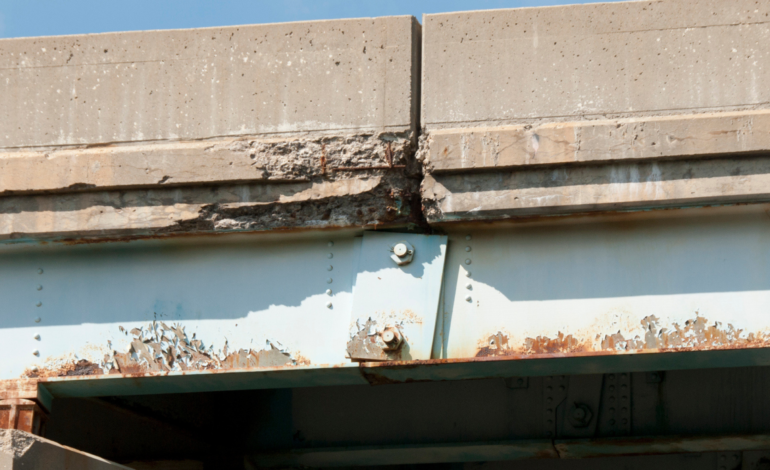
Rust occupies more volume than the original steel, creating expansive pressure that can contribute to cracking, delamination, and eventual spalling of surrounding concrete.
MnDOT identified moisture, temperature fluctuations, and exposure to deicing salts as important contributors to deterioration in Minnesota bridge environments.
THE STRUCTURAL QUESTION
How much reinforcing steel is actually left?
Cracking and spalling show that deterioration is occurring, but structural evaluation depends on estimating how much of the original steel cross section remains.
Why Is Rebar Section Loss Difficult to Estimate?
Bridge inspectors can identify visible cracks, delaminated concrete, spalling, exposed reinforcement, and other signs of corrosion damage. The challenge is translating those observations into an accurate estimate of steel loss.
When a reinforcing bar is exposed, an inspector may visually assess it or measure the remaining diameter. But corrosion is often irregular rather than uniform. Pitting and uneven material loss can make a single diameter measurement a poor representation of the remaining cross-sectional area.
The problem becomes even harder when the steel remains embedded and cannot be observed directly.
WHY VISUAL ESTIMATES CAN MISS THE MARK
A reinforcing bar can look heavily rusted without having lost as much structural steel as expected—or appear less severe while localized pitting has removed a significant portion of the cross section. That makes appearance alone an imperfect measurement of remaining steel.
What Was the Goal of the MnDOT Research?
MnDOT wanted better guidance for estimating reinforcement section loss so engineers could make more informed decisions about preventive maintenance, repair, strengthening, or replacement.
More reliable estimates can help engineers avoid two costly types of error:
Overestimating Damage
An overly conservative section-loss estimate can underestimate structural capacity and potentially lead to unnecessary strengthening, restrictions, or repair.
Underestimating Damage
An unconservative estimate can overstate structural capacity and reduce the intended margin of safety.
STUDY CONDITIONS
The guidance developed in this project was calibrated specifically around standardized 2-inch (50.8 mm) concrete cover over reinforcement and 4,000 psi (27.6 MPa) concrete. Those assumptions matter when interpreting the results.
Two Models for Estimating Rebar Section Loss
Researchers identified two different situations because reinforcement that remains hidden inside cracked concrete presents a different inspection problem from reinforcement exposed by delamination or spalling.
SITUATION 1 · CRACKED CONCRETE
Reinforcement cannot be observed directly
When concrete remained substantially intact but visible cracking had developed, researchers used crack width as the primary indicator for estimating reinforcement section loss.
The physical basis is the expansion of corrosion products: as steel corrodes and rust volume increases, pressure develops against the surrounding concrete and can contribute to cracking.
SITUATION 2 · DELAMINATED OR SPALLED CONCRETE
Reinforcement is exposed
Where corrosion damage had caused concrete to delaminate or spall and the reinforcement could be observed, researchers found large variability in actual section loss.
For this condition, the model ultimately used reinforcement age because researchers did not identify a stronger correlation with the other evaluated factors.
TWO CONDITIONS · TWO DIFFERENT SIGNALS
Crack width helped when the bar was hidden. Exposure age was used when corrosion damage had already opened the concrete.
The distinction matters because the visible condition of the concrete changes what inspectors can observe and how reliably those observations relate to steel loss.
How Researchers Tested the Prediction Models
A bridge near Minneapolis that was already scheduled for concrete repair gave the researchers an opportunity to compare visible field conditions with the actual condition of reinforcing steel uncovered during repair.
01 · MAP THE DAMAGE
Document visible conditions before repair
Researchers photographed and mapped cracking and delaminated concrete before repair work exposed the reinforcement.
02 · EXPOSE THE REBAR
Compare predicted damage with actual steel
During repair, researchers documented actual corrosion conditions and visually assessed the reinforcement after the surrounding concrete was removed.
03 · REMOVE SAMPLES
Take selected reinforcing bars to the laboratory
Selected rebar samples were removed so rust could be cleaned away and the remaining steel measured more precisely.
04 · 3-D SCAN THE STEEL
Measure the true remaining cross section
Researchers used 3-D scanning to reconstruct the bars and calculate cross-sectional area along the corroded reinforcement.
05 · TEST STRENGTH
Connect geometry with mechanical performance
Mechanical testing helped researchers evaluate the strength and failure behavior of the corroded reinforcing samples.
What Did the Researchers Learn?
FINDING 1
Visual estimates were not consistently reliable
The field study showed wide variation in both the location and severity of reinforcement corrosion after concrete had delaminated or spalled. Visual assessment was particularly difficult when reinforcing bars remained rust-covered or partially embedded.
FINDING 2
3-D scanning provided a more exact measurement
Laboratory 3-D scans allowed researchers to calculate the remaining cross-sectional area directly. Mass-based measurements were also consistent with the scan results.
FINDING 3
Visual judgment behaved differently at low and high section loss
When combined with tensile-test results, the researchers concluded that visual-only estimates could be conservative when actual section loss was very low, but could become unconservative as section loss increased.
FINDING 4
The models can support better engineering judgment—but uncertainty remains
The resulting guidance tables provide estimated section loss ranges rather than a single exact value, reflecting the variability inherent in corrosion damage and field conditions.
WHY THE RANGE MATTERS
A model can narrow uncertainty without eliminating it.
The guidance is intended to support engineering evaluation—not replace structural analysis, field investigation, or professional judgment about the condition of a particular bridge.
“The upper bound of section loss estimated by the model for cracked concrete will be helpful to avoid being overly conservative by closing a bridge when we don’t have to.”
— Paul Pilarski, Bridge Construction and Scoping Engineer, MnDOT Bridge Office
What’s Next for the Rebar Section-Loss Models?
The researchers and MnDOT noted that the models still contain broad ranges. Additional data from more bridges could improve accuracy by expanding the number of samples and capturing a wider range of bridge ages, locations, corrosion conditions, and exposure environments.
MnDOT planned to continue collecting reinforcement samples during major bridge repair projects so the models could be refined as more field data became available.
WHY THIS RESEARCH MATTERS
Better condition estimates can lead to better maintenance decisions.
When engineers understand the likely range of reinforcement loss more accurately, they can make better-informed decisions about repair scope, strengthening, monitoring, restrictions, and future maintenance while balancing safety, cost, and disruption to the traveling public.
Common Questions About Rebar Corrosion in Concrete Bridges
Quick answers based on the MnDOT bridge corrosion research described in this article.
Why does corroding rebar crack concrete?
Corrosion products such as rust occupy more volume than the original steel. As corrosion progresses, that expansion can create pressure against the surrounding concrete and contribute to cracking, delamination, and spalling.
What is rebar section loss?
Section loss is the reduction in the cross-sectional area of reinforcing steel caused by corrosion or other deterioration. The amount of steel remaining is important when evaluating the reinforcement’s structural contribution.
Can crack width indicate how much rebar has corroded?
In the MnDOT study, crack width was used as an input for estimating section loss where the reinforcing bar remained embedded in concrete. The relationship was calibrated for the specific bridge conditions and assumptions used in the research, so it should not be treated as a universal equation for all concrete structures.
Why isn’t visual inspection enough to measure rebar section loss?
Corrosion can be highly irregular, with localized pitting and uneven loss around the bar. Rust can also obscure the steel surface. As a result, appearance or a single diameter measurement may not accurately represent the remaining cross-sectional area.
How did researchers measure actual section loss?
Selected reinforcing bars were removed, cleaned of corrosion products, and evaluated in the laboratory. Researchers used 3-D scanning to calculate remaining cross-sectional area and compared those results with mass measurements and mechanical testing.
SOURCE & ORIGINAL PUBLICATION
Source: Minnesota Department of Transportation research.
This article, by Ben DuBose, first appeared on MaterialsPerformance.com on February 1, 2023. Reprinted with permission.
EXPLORE MATERIALS PERFORMANCE
More Research on Corrosion and Infrastructure
Explore technical reporting and research covering reinforced concrete, bridge corrosion, materials performance, inspection, and asset integrity.
EXPLORE MORE
Concrete & Corrosion Resources
AMPP Corrosion Reference Library →
Materials Performance →
AMPP Education →

Have photos or videos from the field? Submit them to AMPP →