Protecting Steel-Reinforced Concrete Marine Structures from Corrosion
MARINE STRUCTURES · REINFORCED CONCRETE · CATHODIC PROTECTION · CHLORIDE EXPOSURE
Marine concrete structures face a difficult combination: porous concrete, embedded steel, moisture, oxygen, and chlorides. Once the reinforcing steel loses its naturally protective passive condition, corrosion can become an asset-integrity problem.
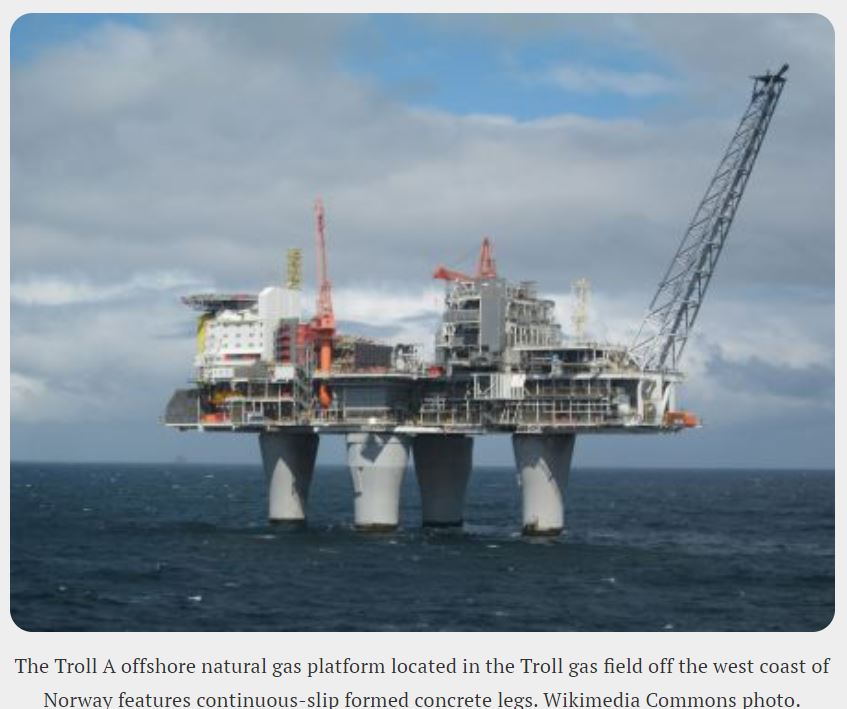
Steel-reinforced concrete is widely used for foundations, pilings, pile caps, bridge components, seawalls, piers, and other marine infrastructure. Concrete normally provides corrosion protection to the embedded reinforcement, but chloride exposure and other environmental factors can eventually change that condition.
THE CORROSION PATH
Chlorides Enter the Concrete
↓
They Reach the Reinforcing Steel
↓
Passive Protection Breaks Down
↓
Corrosion of the Reinforcement Can Accelerate
Why Reinforcing Steel Is Normally Protected Inside Concrete
Steel and concrete work well together structurally, and the high alkalinity of conventional Portland cement concrete can also help protect embedded reinforcing steel from corrosion.
Under favorable conditions, the alkaline environment promotes formation of a thin passive film on the steel surface. That film significantly reduces the rate of corrosion while the surrounding concrete environment remains supportive of passivity.
Problems arise when external conditions alter that environment or aggressive ions reach the reinforcement in sufficient concentration to destabilize the protective condition.
CONCRETE IS PROTECTIVE — BUT NOT IMPERMEABLE
Concrete contains a network of pores. Moisture, chlorides, and other dissolved substances can move through that pore structure over time by mechanisms that include absorption, diffusion, and capillary transport.
How Chlorides Reach the Reinforcing Steel
Marine structures may be exposed continuously or intermittently to seawater, salt spray, tidal wetting, or chloride-containing moisture. Structures in colder climates may also be exposed to chlorides from deicing salts.
These dissolved salts can move through the concrete matrix until they reach the reinforcing steel. When chloride concentrations at the steel surface become sufficiently aggressive for the specific system, the passive film may break down and localized corrosion can begin.
How quickly this occurs depends on many variables rather than a single universal threshold or time period.
FACTORS THAT CAN AFFECT CHLORIDE INGRESS
- Chloride concentration at the exposed surface
- Concrete permeability and durability
- Concrete cover over the reinforcement
- Cracking and construction defects
- Moisture availability
- Temperature and exposure duration
- Wetting and drying cycles
- Concrete resistivity
- Existing contamination and repair history
What Happens After Reinforcing Steel Begins to Corrode
Once reinforcing steel becomes actively corroding, the problem extends beyond loss of steel section. Corrosion products can occupy more volume than the original metallic iron, generating expansive stresses within the surrounding concrete.
Over time, those stresses can contribute to cracking, delamination, spalling, loss of bond, and additional pathways for moisture and chlorides to reach the reinforcement.
This is why corrosion mitigation in chloride-contaminated reinforced concrete often needs to address the electrochemical corrosion process itself rather than only patching visible concrete damage.
VISIBLE DAMAGE MAY BE A LATE SIGNAL
The corrosion process can begin before cracking and spalling become obvious.
Assessment of marine concrete structures may therefore require a combination of visual inspection, concrete evaluation, chloride testing, electrical measurements, reinforcement assessment, and other appropriate diagnostic methods.
Cathodic Protection for Reinforced Concrete
Cathodic protection (CP) is an electrochemical corrosion-control technique that applies protective current to the reinforcing steel so that the steel behaves as the cathode of the corrosion-control system.
In reinforced concrete applications, the steel reinforcement is the structure being protected, while the concrete functions as the electrolyte through which ionic current can flow. An anode supplies protective current, and electrical continuity completes the circuit.
The objective is to alter the electrochemical behavior of the reinforcing steel enough to reduce or control active corrosion.
THE BASIC CP CIRCUIT
Anode
↓
Protective Current
↓
Concrete Electrolyte
↓
Reinforcing Steel Becomes the Protected Cathode
Two Main Types of Cathodic Protection
Reinforced-concrete CP systems generally fall into two broad categories: impressed current cathodic protection and sacrificial, or galvanic, anode cathodic protection.
ICCP
Impressed Current Cathodic Protection
Uses an external power source to drive protective current from the anode system to the reinforcing steel.
SACP
Sacrificial Anode Cathodic Protection
Uses galvanic anodes made from metals that are more electrochemically active than the reinforcing steel.
How Impressed Current Cathodic Protection Works
ICCP uses an external DC power source to supply and control protective current. Depending on the system, the source may include a rectifier or another suitable power supply.
The current output can be adjusted as conditions change over the life of the system. That controllability is one of ICCP’s major advantages, but it also means the system requires monitoring, maintenance, and operational attention.
The source notes that ICCP systems may operate under current-controlled or voltage-controlled modes with appropriate limits, depending on system design.
ICCP REQUIRES CONTROL
More protective current is not automatically better. ICCP output should be controlled within the limits established for the structure and reinforcement system, and performance should be verified through appropriate monitoring.
Why prestressed reinforcement requires special attention
The source specifically cautions against overprotection of prestressed steel because excessive cathodic polarization can increase the risk of hydrogen-related damage in susceptible high-strength steels. Systems involving prestressing steel therefore require appropriate design limits, monitoring, and qualified engineering evaluation.
How Sacrificial Anode Cathodic Protection Works
Sacrificial anode cathodic protection uses a metal that is more electrochemically active than the reinforcing steel. When the anode and steel are electrically connected through the concrete electrolyte, the galvanic anode preferentially corrodes while supplying protective current to the reinforcement.
Galvanic systems used with reinforced concrete can take several forms, including discrete anodes, bars, meshes, metallic coatings, jackets, and other configurations selected for the specific structure and exposure.
Unlike an impressed-current system, the driving voltage comes from the electrochemical difference between the anode material and the reinforcing steel rather than an external rectifier.
GALVANIC CP
More Active Anode Material
↓
Anode Is Consumed
↓
Protective Current Flows Through the Concrete
↓
Reinforcing Steel Receives Protection
Why Galvanic Systems Are Often Described as Self-Regulating
The current output of a galvanic system responds naturally to the electrochemical conditions between the anode and the reinforcing steel. Changes in concrete moisture, resistivity, steel condition, temperature, and other factors can therefore influence the amount of current delivered.
That behavior can reduce the need for active current adjustment compared with ICCP, but it also means that most galvanic systems cannot simply be turned up if the available current is insufficient.
The anodes are also consumable components. Their service life depends on anode capacity, current demand, environmental conditions, installation, and system design.
Marine Exposure Is Not the Same Everywhere on the Structure
One of the biggest challenges in marine reinforced concrete is that different portions of the same structure may experience very different electrochemical environments.
SUBMERGED ZONE
High moisture and chloride exposure
Concrete may be highly saturated with chloride-containing water. Oxygen availability can become a limiting factor in the corrosion reaction at deeply submerged locations.
TIDAL & SPLASH ZONE
Often one of the harshest exposure areas
Repeated wetting and drying can provide both chlorides and oxygen, creating conditions capable of supporting high reinforcement-corrosion rates.
ATMOSPHERIC / SUPERSTRUCTURE ZONE
More oxygen, often less direct saturation
Components farther from the water may remain drier, but salt spray, sea breeze, runoff, and deicing salts can still create significant chloride exposure.
MARINE CORROSION IS ZONE-DEPENDENT
One pier can contain several different corrosion environments.
Submerged, tidal, splash, atmospheric, and deicing-salt exposure zones can differ in chloride content, moisture, oxygen availability, resistivity, current demand, and deterioration rate. CP design should account for those differences.
Choosing Between ICCP and Galvanic CP
Neither impressed current nor galvanic CP is automatically the right choice for every marine structure. The appropriate approach depends on the condition of the concrete and reinforcement, available electrical continuity, chloride contamination, current demand, geometry, access, desired service life, maintenance strategy, and other project-specific factors.
ICCP MAY OFFER
- Adjustable current output
- Higher available driving voltage
- Ability to respond to changing current demand
- Long-term system control
GALVANIC CP MAY OFFER
- No external rectifier
- Natural response to electrochemical conditions
- Simpler operation in some applications
- Discrete or distributed anode options
Those characteristics are not substitutes for engineering design. Anode type, quantity, location, expected life, monitoring strategy, current distribution, electrical continuity, and acceptance criteria still need to be selected for the actual asset.
Cathodic Protection Still Requires Monitoring
Cathodic protection is not a “set it and forget it” strategy. The original paper emphasizes the importance of monitoring and maintaining CP systems so that they continue supplying effective levels of protective current.
That is particularly important for ICCP, where system output can be deliberately adjusted, but galvanic systems also need periodic evaluation because anodes are consumed and system conditions can change.
A LONG-TERM CP PROGRAM MAY NEED TO TRACK
- Electrical continuity of the reinforcing steel
- Anode condition and consumption
- Current output
- System voltage
- Reference-electrode measurements
- Polarization or depolarization behavior
- Concrete condition and repair history
- Environmental changes
- Rectifier or power-supply performance for ICCP
- Changes in protection criteria over the system life
THINK IN LIFECYCLE TERMS
Assess the Concrete & Reinforcement
↓
Design the CP System
↓
Commission & Establish Baselines
↓
Monitor & Maintain
↓
Reassess as the Structure Ages
What This Means for Marine Asset Owners
The challenge with chloride-contaminated reinforced concrete is that deterioration may continue even after visibly damaged concrete is repaired if the underlying corrosion environment remains active.
Cathodic protection offers a way to directly influence the electrochemical corrosion process, which is why it has been used for decades on bridge, marine, parking, and other reinforced-concrete structures.
Successful application still depends on understanding the structure, exposure zones, reinforcement, chloride distribution, electrical continuity, concrete condition, required current, service-life goals, inspection access, and long-term maintenance capability.
BOTTOM LINE
Marine reinforced concrete is protected naturally only as long as the environment around the steel supports passivity. Once chlorides and other conditions destabilize that protection, cathodic protection can be used to directly control the electrochemical corrosion process.
TECHNICAL NOTE
Cathodic protection design, protection criteria, current limits, anode selection, reference electrodes, prestressing-steel considerations, monitoring frequency, and system acceptance should follow current applicable standards, project requirements, manufacturer guidance, and qualified corrosion-engineering practice.
Reference
1. Long-Term Effectiveness of Cathodic Protection Systems on Highway Structures, U.S. Federal Highway Administration, FHWA-RD-01-096, April 2001.
SOURCE
This article was originally published by Materials Performance Magazine and is based on work by Douglas L. Leng presented at CORROSION 2017.
The original technical paper was identified as CORROSION 2017 paper no. 9219, “Cathodic Protection on Steel Reinforced Concrete Marine Structures,” by D. L. Leng. Republished with permission.
MARITIME CORROSION RESOURCES
Explore Corrosion Protection for Marine Assets
AMPP resources cover cathodic protection, reinforced concrete, coatings, marine corrosion, inspection, materials selection, and asset-integrity strategies.
EXPLORE MORE
Marine, Concrete & Cathodic Protection Resources
Maritime Corrosion Resources →
Cathodic Protection Resources →
Corrosion Reference Library →
AMPP Education →
AMPP Standards →

Have photos or videos from the field? Submit them to AMPP →