Fresh Coating Protects Ship Carrying 2024 Olympic Torch

MARITIME · COMPOSITE REPAIR · PROTECTIVE COATINGS
2024 OLYMPIC TORCH JOURNEY · MARSEILLE, FRANCE
When the historic three-masted ship Belem carried the Olympic flame into Marseille in May 2024, it represented more than a ceremonial arrival. It also showcased how modern repair materials and protective coatings can help preserve historic maritime assets for continued service.
More than 150,000 spectators gathered as the vessel entered the bay accompanied by a flotilla of more than 1,000 boats. Behind that moment was extensive restoration work—including repair of a severely corroded propeller shaft that the vessel’s owners hoped to preserve rather than replace.
AT A GLANCE
Preserving a historic ship for a historic journey
- Asset: The historic French three-masted ship Belem
- Problem: Heavy corrosion and pitting on the propeller shaft
- Goal: Retain and rebuild the original shaft rather than replace it
- Repair: Composite rebuilding followed by protective coating
- Environment: Seawater immersion and marine exposure
- Outcome: The historic shaft remained in service for the vessel’s 2024 Olympic torch voyage
A Ship With More Than a Century of History
The Belem is regarded as one of the last great French merchant sailing ships. The three-masted vessel made its maiden voyage in 1896 and originally transported cargo including sugar, cocoa, and coffee between South America, the Caribbean, and France.
Today, the ship combines its historic sailing configuration with modern equipment. It carries 22 sails with a total surface area of approximately 1,200 m² (12,917 square feet) and is also equipped with two 575-hp (429-kW) diesel engines.
Its history has included more than one dramatic chapter. The vessel survived a fire during its early service life and continued operating through multiple changes in ownership, use, and restoration. More than a century later, preserving original components remains part of maintaining the ship’s historic character.
PRESERVATION CHANGES THE REPAIR QUESTION
On a historic asset, replacement is not always the preferred solution. Repair strategies may need to address structural or service requirements while also preserving as much original material as practical.
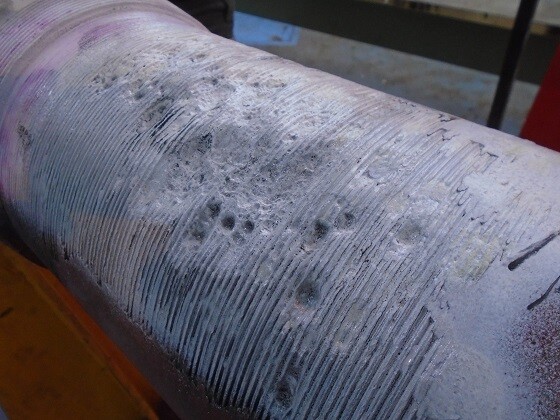
The original propeller shaft showed significant corrosion and pitting before restoration.
Corrosion Threatened an Original Propeller Shaft
After decades of marine service, the Belem‘s propeller shaft had developed heavy corrosion and localized pitting. Because the shaft was part of the historic vessel, the owner wanted to preserve the original component if an appropriate repair could be completed.
A replacement would have involved substantial cost and would have meant removing an original part of the ship. The repair therefore needed to rebuild areas affected by metal loss while providing additional protection against future seawater exposure.
THE REPAIR CHALLENGE
Restore Lost Profile
+
Protect Against Marine Exposure
+
Retain the Historic Component
↓
Return the Shaft to Service
Preparing the Shaft for Repair
Alliatech, an authorized distributor for protective coatings and composite repair materials supplier Belzona, carried out the repair while the Belem was in dry dock at the Saint-Nazaire shipyards in France.
The application surfaces were grit blasted to create an approximately 3–4 mil (76–102 micron) surface profile and prepared to a near-white metal blast-cleaning condition. The surfaces were subsequently salt washed before the repair materials were applied.
SURFACE PREPARATION MATTERS
Composite repairs and protective coatings depend heavily on substrate preparation. The required cleanliness, profile, contamination limits, and application conditions should always follow the governing project specification and product instructions.
Rebuilding the Damaged Metal Profile
Once surface preparation was complete, the areas affected by corrosion and pitting were rebuilt to restore the shaft’s profile.
The repair team used Belzona 1111 (Super Metal), a two-part epoxy-based composite intended for rebuilding and resurfacing metallic components. The material was mixed on site and applied with a spatula to fill damaged areas and recreate the required surface geometry.
For this project, the composite repair offered a way to restore localized material loss without removing the historic shaft from service entirely.
Adding Protection for Immersion Service
After the shaft profile was rebuilt, two coats of Belzona 5821 were brush applied to provide additional protection against erosion and corrosion during immersion service.
The product is an epoxy-based, ceramic-filled, solvent-free coating designed for submerged equipment and other environments where surfaces may be exposed to water and erosion-corrosion conditions.
For the reported application, each coat was applied at approximately 10 mils (254 microns) dry film thickness. Product data sheets and project specifications govern actual application requirements.
THE REPAIR SYSTEM
Grit Blast & Clean the Substrate
↓
Rebuild Pitted Areas With Repair Composite
↓
Apply Protective Immersion Coating
↓
Return the Historic Shaft to Service
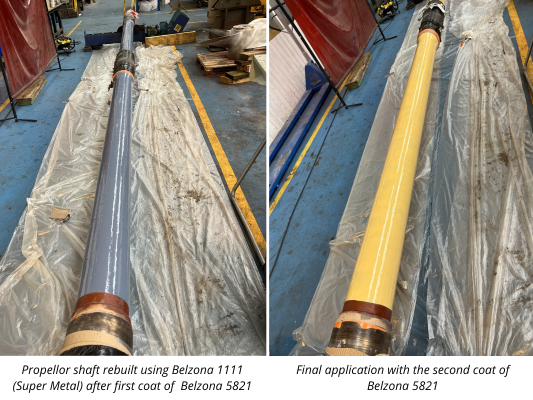
The damaged propeller shaft during the restoration process.
Preserving the Original Shaft
The completed repair allowed the original shaft—more than 125 years old at the time of the project—to remain in service. For the vessel’s owners, that meant avoiding replacement while preserving a physical piece of the ship’s history.
The project also illustrates a broader role for composite repair and protective coatings: under appropriate conditions and with suitable engineering evaluation, repair technologies can help extend service life while reducing the need to remove and replace existing components.
REPAIR DOES NOT AUTOMATICALLY EQUAL FITNESS FOR SERVICE
Whether a damaged component can be repaired rather than replaced depends on the asset, extent and mechanism of damage, loading, service environment, engineering requirements, inspection findings, applicable standards, and project specifications.
From the Shipyard to the Olympic Stage
Following ceremonies in Greece, the Olympic flame began its journey toward France aboard the restored Belem. The vessel sailed approximately 2,000 km (1,243 miles) from Piraeus to Marseille as part of the Paris 2024 Olympic torch relay.
The flame was guarded throughout the voyage before the ship reached the French coast in May 2024, where Marseille welcomed the vessel with large crowds, accompanying boats, aerial displays, and celebrations.
FROM THE PROJECT TEAM
“It is fantastic to see Belzona make history on board the Belem.”
Frédéric Harle
Director, Alliatech
What This Project Shows About Materials Protection
The Belem project demonstrates how preservation, engineering, surface preparation, composite repair, and protective coatings can work together on a difficult marine asset.
For historic equipment in particular, materials-protection strategies may offer something beyond conventional maintenance: the opportunity to retain original components while addressing deterioration and supporting continued service.
BOTTOM LINE
Sometimes materials protection is not only about extending asset life—it is about preserving history while keeping an asset capable of performing its next job.
SOURCE
By Ben DuBose. This article first appeared on CoatingsPro Magazine on July 2, 2024. Reprinted with permission.
MARITIME MATERIALS PROTECTION
Explore More Marine Corrosion Resources
Learn more about coatings, corrosion prevention, cathodic protection, inspection, and materials performance in marine environments.
EXPLORE MORE
Marine Corrosion & Coatings
Maritime Corrosion Resources →
Corrosion Reference Library →
Cathodic Protection →
AMPP Education →
CoatingsPro Magazine →

Have photos or videos from the field? Submit them to AMPP →