Researchers Use Machine Learning to Detect Pitting Corrosion
ARTIFICIAL INTELLIGENCE · ULTRASOUND · CORROSION MONITORING
Could artificial intelligence identify the early signs of pitting corrosion hidden inside an ultrasonic signal? Researchers in Norway are exploring how machine learning could reveal changes that are difficult to distinguish using conventional signal-processing methods.
In their 2024 AMPP paper, Pitting Corrosion Detection by Ultrasound Monitoring, Magnus Wangensteen, Tonni Franke Johansen, Ali Fatemi, and Erlend Magnus Viggen investigated whether time-lapse ultrasonic data could be combined with neural networks to detect and estimate the depth of small defects in steel.
IMPORTANT RESEARCH CONTEXT
The experiment used precision-drilled holes to represent pit-like defects. The researchers reported promising results, but detecting and characterizing irregular pits created by actual corrosion remains a future research objective.
THE RESEARCH QUESTION
Ultrasonic Monitoring Over Time
+
Machine Learning
↓
Detect Small Changes in the Signal
↓
Potential Earlier Insight Into Localized Damage
From AI Predictions to Corrosion Research
At the 2024 AMPP Conference + Expo in New Orleans, physicist Michio Kaku discussed a future in which artificial intelligence and machine learning could influence coatings and corrosion prevention. For the Trondheim-based research team, those technologies were already becoming part of the corrosion-monitoring toolbox.
Their work focuses on whether machine learning can recognize patterns in ultrasonic measurements that may be difficult to isolate using traditional processing techniques.
FROM THE RESEARCH TEAM
“Tiny changes in signals are difficult to distinguish using traditional methods.”
Magnus Wangensteen
Ultrasound researcher and study co-author
Why Pitting Corrosion Is Difficult to Detect
Pitting corrosion is a localized form of attack that can produce small cavities in a metallic surface. Unlike broadly distributed wall loss, a pit may occupy only a small area while penetrating more deeply into the material.
Ultrasonic inspection is an established nondestructive testing technique, but identifying small pits close to a reflective back-wall surface can be challenging because the pit response can interact with the much stronger reflection from that surface.
01 · REFLECTION DIFFICULTIES
The pit signal can overlap with the back-wall reflection
When localized damage occurs near a reflective interface, separating the response from the pit from the primary wall reflection can be difficult.
02 · INTERFERENCE EFFECTS
Scattered waves can alter the apparent wall response
A small defect can scatter an incoming ultrasonic wave. That scattered signal may interfere with the primary back-wall reflection and introduce errors into conventional thickness estimates.
03 · EARLY-STAGE DISTORTION
Early pit growth may produce subtle changes
Small distortions in the reflected signal may create an undulating response as a defect develops, making interpretation more difficult using straightforward wall-thickness measurements alone.
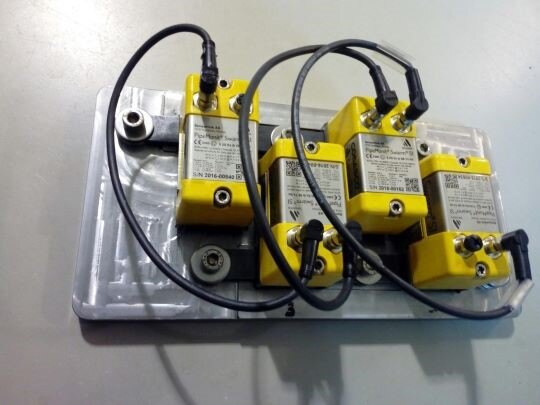
Four ultrasound sensors recorded data from the opposite side of the steel plate while holes were drilled incrementally into the specimen.
Where Machine Learning Enters the Picture
Instead of looking only at a single ultrasonic measurement, the researchers captured multiple traces over time. Those measurements could be combined into two-dimensional time-lapse images showing changes in ultrasonic reflectivity.
The resulting images became input data for neural networks trained to recognize whether a pit-like defect was present and to estimate how deep it was.
THE EXPERIMENTAL WORKFLOW
Record Repeated Ultrasonic Measurements
↓
Create Time-Lapse Reflectivity Images
↓
Train Neural Networks
↓
Classify Defects & Estimate Depth
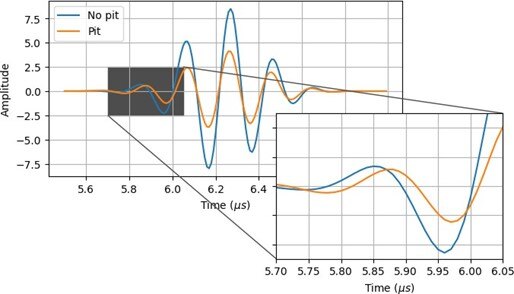
The diagram illustrates how a scattered wave from the defect can reach the transducer before the primary back-wall pulse.
Building a Controlled Dataset
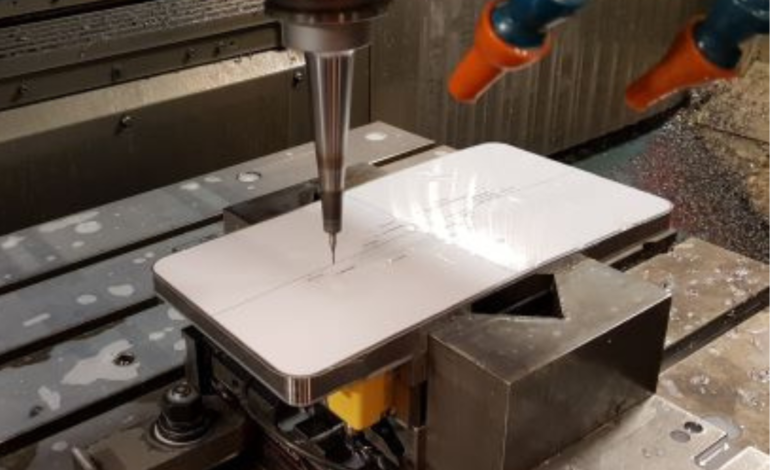
One challenge in training machine-learning models is knowing the true condition of the material associated with every measurement. For this study, the researchers used a high-precision drilling machine to create holes incrementally in a steel plate. Because the depth of each machined hole was controlled, they could establish a high-confidence reference for the defect depth represented in the ultrasonic data.
Random, time-ordered combinations of pulse-echo measurements were then used to construct time-lapse datasets. A classification neural network was trained to identify whether pit-like defects were present, while a regression network estimated defect depth.
The researchers tested the models on data from a transducer that had not been included in the training process, providing a way to evaluate how the system performed on unseen measurements.
REPORTED EXPERIMENTAL RESULTS
Promising performance on the drilled-hole dataset
- Pit-depth estimates had a mean absolute error below 0.2 mm on the reported unseen test data.
- The researchers reported reliable identification once defects exceeded their defined 0.5 mm pitting threshold by 0.1 mm.
Important: These results were obtained using controlled, machined defects. They should not be interpreted as equivalent performance for naturally formed corrosion pits in field conditions.
Moving From Simulation Toward Real-World Measurements
The team’s 2024 experiment followed earlier research into ultrasonic guided waves and machine learning. Their 2023 AMPP work relied on ultrasound simulations and synthetic data. The newer project moved the research closer to physical measurements by collecting ultrasonic data from an actual steel specimen as controlled defects were created.
That transition matters because laboratory simulations allow researchers to control parameters that may vary substantially on real equipment. Surface condition, geometry, temperature, material variability, noise, instrumentation, and irregular corrosion morphology can all complicate field measurements.
THE NEXT VALIDATION STEP
Can the model recognize pits produced by actual corrosion?
The researchers attempted to create corrosion pits under controlled conditions but were unsuccessful. Their stated next step is to generate real growing pits and determine whether a neural network trained on controlled data can detect and characterize those more irregular defects.
Why AI Could Be Useful for Corrosion Monitoring
The potential advantage of machine learning is not that it changes the physics of ultrasonic inspection. Instead, it may provide another way to interpret complex measurement patterns.
A conventional analysis may struggle to isolate a useful parameter when several signals overlap. A trained model, given enough representative data with known outcomes, may be able to recognize combinations of features that correlate with specific material conditions.
In a future monitoring system, that capability could potentially help operators prioritize large volumes of sensor data and identify measurements that warrant closer investigation.
AI AS A SIGNAL-PROCESSING TOOL
The goal is better information—not replacing sound inspection practice.
Machine-learning output still depends on representative training data, measurement quality, validation, appropriate sensor placement, engineering context, and understanding the limitations of the model.
Beyond Pitting Detection
The researchers see potential applications beyond identifying individual pits. Time-lapse ultrasonic monitoring combined with machine learning could also be explored for recognizing other changes in material condition.
SURFACE CHANGE
General wall roughness development
DEPOSITS
Scaling formation
MATERIAL CONDITION
Changes associated with embrittlement
OPERATING CONDITIONS
Temperature-related changes
What Could This Mean for Plant Operators?
Long-term monitoring can produce large quantities of data. If validated for real corrosion conditions, AI-assisted analysis could eventually help screen those measurements, identify subtle trends, and surface signals that deserve additional attention.
Sensorlink, where Wangensteen and Fatemi work, also has ultrasound data from field installations that the team hopes can support additional model development.
The larger opportunity is not necessarily a fully autonomous corrosion diagnosis. It is the possibility of using machine learning to extract useful information from monitoring signals that might otherwise be difficult to interpret efficiently.
About the Researchers
Magnus Wangensteen is an ultrasound expert with Sensorlink and has a background in geophysics and ultrasonic pipe-condition assessment.
Ali Fatemi is an ultrasound engineer with Sensorlink and earned his Ph.D. from the Norwegian University of Science and Technology (NTNU), where his research involved cardiac ultrasound imaging.
Tonni Franke Johansen is a research scientist with SINTEF whose work includes acoustics.
Erlend Magnus Viggen has a Ph.D. in acoustics and has worked in acoustics and ultrasonics research at SINTEF and NTNU.
A Promising Step—With More Validation Ahead
This research shows how machine learning may complement established nondestructive testing techniques by extracting information from complex ultrasonic signals. In the controlled drilled-hole experiment, the models demonstrated the ability to classify defects and estimate their depth with promising accuracy.
The next challenge is more difficult—and more important for practical corrosion monitoring: demonstrating that similar approaches can reliably identify the irregular geometry and changing conditions associated with actual corrosion pits.
BOTTOM LINE
AI may help corrosion professionals find useful information hidden inside complex monitoring data—but controlled defect detection is an important research step, not the same as validated field detection of naturally occurring pits.
SOURCE
By Kerry Cole. This article first appeared in the June 2024 print issue of Materials Performance Magazine. Reprinted with permission.
CORROSION RESEARCH
Explore More Corrosion Research and Technical Resources
Discover research, case studies, technical information, and practical resources covering corrosion monitoring, inspection, materials performance, and emerging technologies.
EXPLORE MORE
Corrosion Monitoring & Research
Materials Performance Magazine →
Corrosion Reference Library →
AMPP Education →
AMPP Standards →

Have photos or videos from the field? Submit them to AMPP →