Study: North American Waterways Becoming Saltier, More Alkaline
WATER CHEMISTRY · CORROSION · INFRASTRUCTURE · DRINKING WATER
Changes in freshwater chemistry can affect much more than ecosystems. Salinity, alkalinity, dissolved ions, and pH can also influence corrosion, scale formation, and the behavior of metals in drinking-water and infrastructure systems.
A multi-institution research study published in 2018 documented long-term increases in salinization and alkalinization at many freshwater monitoring locations across the United States. The researchers described the combined trend as part of what they called Freshwater Salinization Syndrome.
WHY WATER CHEMISTRY MATTERS
Salts Enter the Watershed
↓
Water Chemistry Changes
↓
Corrosion & Scaling Behavior May Change
↓
Infrastructure & Water Quality Can Be Affected
What Is Freshwater Salinization Syndrome?
The study’s lead author, Sujay Kaushal of the University of Maryland, used the term Freshwater Salinization Syndrome to describe a suite of water-quality changes associated with increasing concentrations of multiple dissolved salt ions.
The concern is broader than sodium chloride alone. In water chemistry, salts include combinations of positively and negatively charged ions. Common cations can include sodium, calcium, magnesium, and potassium, while the broader chemical mixture depends on the source and surrounding geology.
The researchers emphasized that different ions can interact with soils, sediments, rocks, and infrastructure in complex ways. In some cases, mixtures of salts may behave differently from a single salt considered by itself.
SALINITY IS NOT JUST “ROAD SALT”
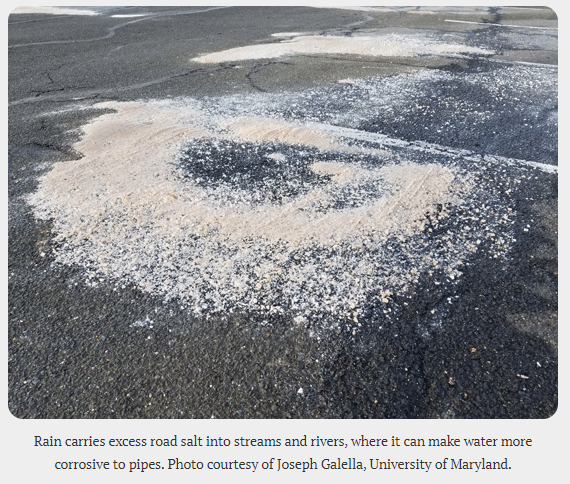
Road deicers are an important source in many regions, but fertilizers, weathering of concrete and minerals, mining-related inputs, wastewater, and other human or natural processes can also contribute dissolved ions to freshwater systems.
Why This Matters for Corrosion
Water chemistry is one of the major factors controlling corrosion in metallic systems. Changes in ionic strength, chloride concentration, pH, alkalinity, dissolved oxygen, temperature, protective scale formation, and treatment chemistry can all affect how metals behave in service.
Higher salt concentrations can increase the electrical conductivity of water, which may influence electrochemical corrosion processes. Specific ions, especially chlorides, can also interfere with protective films or contribute to localized corrosion under some conditions.
The effect is not determined by salinity alone. A complete corrosion assessment must consider the full chemistry of the water, the pipe or component material, treatment practices, deposits, flow, temperature, age, protective scales, and operating history.
CORROSION DEPENDS ON THE SYSTEM
Water Chemistry
+
Material
+
Treatment & Protective Scale
+
Flow & Operating Conditions
↓
Actual Corrosion Behavior
The Flint Water Crisis Highlighted the Importance of Corrosion Control
The original article referenced the Flint, Michigan, water crisis as an example of how changes in source-water chemistry and corrosion-control conditions can have serious consequences for drinking-water infrastructure.
When Flint changed its water source in 2014, the new water chemistry interacted with the distribution system in ways that increased corrosivity and contributed to lead release from plumbing and service lines.
The broader lesson is that changing source water, treatment chemistry, or operating conditions should be evaluated not only for water-quality compliance but also for their effect on corrosion control and existing pipe scales.
IMPORTANT DISTINCTION
Salinity alone did not “cause Flint.” Drinking-water corrosion events arise from interactions among source-water chemistry, treatment, pipe materials, protective scales, system operation, and corrosion-control practices. The case is relevant because it shows how consequential those interactions can become.
What the Researchers Studied
The research team analyzed approximately 50 years of freshwater monitoring data from 232 U.S. Geological Survey sites across the United States.
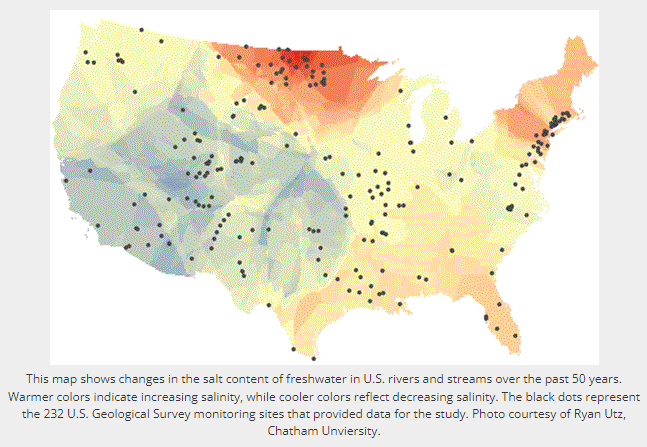
The study examined long-term salinity and pH trends across hundreds of U.S. freshwater monitoring sites.
The researchers reported significant chemical changes in major rivers including the Mississippi, Hudson, Potomac, Neuse, Canadian, and Chattahoochee—many of which serve as important drinking-water sources.
Across the study period, they reported significant increases in salinity across 37% of the drainage area of the contiguous United States and increases in alkalinization across 90% of that area.
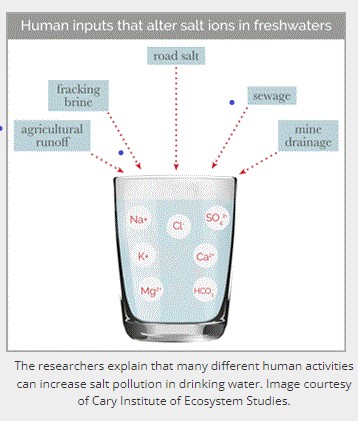
Human activities can introduce different types of dissolved salts into freshwater systems, with sources varying by region.
The Sources of Salt Vary by Region
The study found that there was no single nationwide source responsible for increasing salinity. Different regions showed different dominant contributors.
MID-ATLANTIC & NORTHEAST
Road deicing salts
Winter road maintenance was identified as an important source of salt inputs in colder regions.
AGRICULTURAL MIDWEST
Fertilizer inputs
Agricultural fertilizers, including potassium-containing formulations, were identified as significant contributors in some watersheds.
URBAN AREAS
Built infrastructure
Weathering of concrete and other built materials can contribute dissolved ions to stormwater and waterways.
OTHER REGIONS
Mining & geology
Mining-related materials and natural weathering of rocks and soils can also affect freshwater salinity.
Salt Can Persist in the Environment
One important point from the research was that salt does not simply disappear after being applied to the landscape.
Salts can accumulate in soils and groundwater and may continue moving through a watershed over long time periods. That means changes in salt use today can have effects that persist beyond a single storm or winter season.
WATERSHEDS HAVE MEMORY
Today’s water chemistry can reflect years of accumulated inputs.
For infrastructure managers, long-term changes in source-water chemistry may matter because assets designed and operated under one set of conditions can eventually be exposed to another.
Not Every Region Followed the Same Trend
The researchers reported an important exception in the U.S. Southwest. Although salt concentrations have historically been high in arid regions, the study documented an overall decline in salinity over time in parts of the Southwest.
They attributed the change to a combination of land-use and water-use practices as well as state and local efforts to reduce salt inputs and improve water-resource management.
Strategies the Researchers Identified
The study authors pointed to several ways communities and industries may reduce unnecessary salt loading while still meeting operational needs.
- Improve road-salt application efficiency and equipment calibration.
- Use deicing methods and materials appropriate for actual weather conditions.
- Apply deicers strategically before or during winter events where appropriate.
- Optimize fertilizer timing and quantity to reduce unnecessary runoff.
- Improve stormwater management and drainage design.
- Consider development setbacks and practices that reduce direct runoff into waterways.
- Monitor long-term water chemistry rather than focusing only on individual contaminants.
What Infrastructure Owners Can Take From the Study
This research was primarily about freshwater chemistry, not a design standard for drinking-water corrosion control. But the findings reinforce an important asset-management principle: environmental conditions do not remain fixed forever.
Aging water systems may face changing source waters, changing salt loads, changing pH, changing treatment requirements, and changing deposit conditions over decades of operation.
Monitoring those changes can help utilities and asset owners identify when corrosion-control assumptions need to be revisited.
MONITOR THE ENVIRONMENT, NOT JUST THE ASSET
Track Source-Water Chemistry
↓
Evaluate Treatment & Scale Stability
↓
Monitor Corrosion Indicators
↓
Adjust Asset-Management Strategy When Needed
BOTTOM LINE
Freshwater salinization is not only an environmental issue. Long-term changes in salts, pH, and other water-quality parameters can also change the corrosion environment surrounding pipes and other infrastructure.
HISTORICAL STUDY NOTE
This article summarizes research reported in 2018 using historical monitoring data. The percentages and geographic trends described above reflect that study and should not be interpreted as current measurements of every U.S. watershed. Current water-quality and corrosion decisions should use current local monitoring data and applicable requirements.
References
1. K. Riggs Larsen, “The Science Behind It: Corrosion Caused Lead-Tainted Water in Flint, Michigan,” Materials Performance, June 7, 2016.
2. “North American Waterways are Becoming Saltier and More Alkaline,” University of Maryland College of Computer, Mathematical, and Natural Sciences, January 8, 2018.
SOURCE
This article by Ben DuBose was originally published by Materials Performance Magazine. Original research source: University of Maryland. Republished with permission.
WATER & WASTEWATER RESOURCES
Explore Corrosion in Water and Wastewater Systems
AMPP resources cover drinking-water infrastructure, wastewater assets, coatings, corrosion mechanisms, material selection, inspection, and corrosion-control strategies.
EXPLORE MORE
Water, Wastewater & Corrosion Resources
Water & Wastewater Corrosion Resources →
Corrosion Reference Library →
AMPP Education →
AMPP Standards →
Materials Performance Magazine →

Have photos or videos from the field? Submit them to AMPP →