Corrosion Prevention Using Real-Time Data in Oil Fields

OIL & GAS · CORROSION MONITORING · CHEMICAL TREATMENT · REAL-TIME DATA
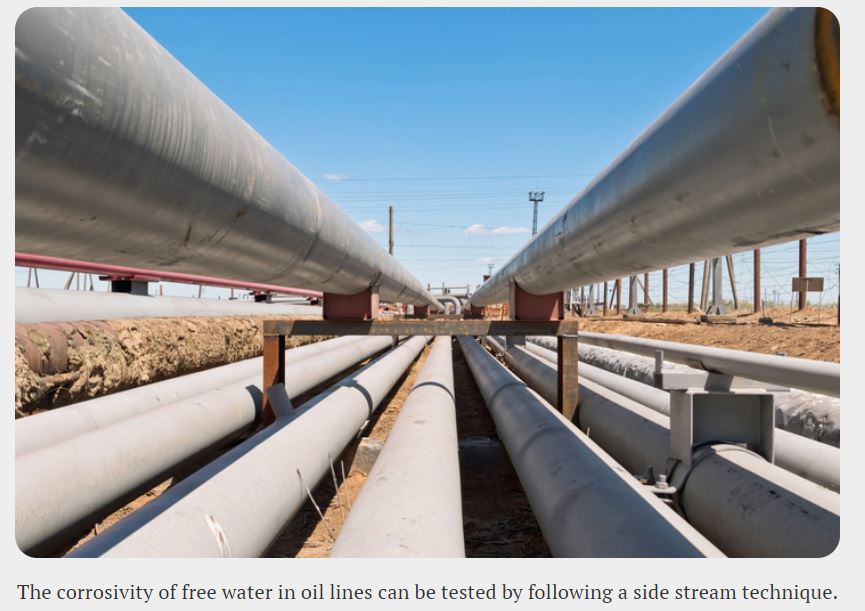
Corrosion monitoring becomes more useful when it does more than document damage after the fact. Real-time data can help operators identify changing corrosion conditions early enough to evaluate and adjust mitigation strategies.
In oil-field and pipeline operations, corrosion conditions can change with fluid chemistry, flow, temperature, pressure, water content, chemical-treatment performance, and other operating variables. Continuous or high-frequency monitoring can help corrosion professionals compare those changes with actual corrosion trends rather than relying only on periodic field observations.
THE REAL-TIME MONITORING ADVANTAGE
Measure Corrosion Conditions
↓
Compare with Operating Data
↓
Identify Changes Earlier
↓
Evaluate Mitigation Response
Real-Time Corrosion Monitoring in Oil-Field Operations
High-resolution corrosion-monitoring instruments, including electrical resistance (ER) probes, can be installed at selected locations within a system and connected to data-acquisition or control systems.
This allows corrosion personnel to observe trends alongside operating parameters such as pressure, temperature, flow, production conditions, and chemical-treatment data. A change in corrosion behavior can then be evaluated in context rather than as an isolated measurement.
The value is not simply that the data are available quickly. The greater benefit is the ability to recognize relationships between corrosion and process conditions that might be missed when measurements are taken only during periodic site visits.
REAL-TIME DOES NOT MEAN AUTOMATICALLY CORRECT
Continuous data still require appropriate sensor selection, installation, calibration, interpretation, and comparison with other integrity information. A faster data stream is valuable only when the measurements are representative of the system being evaluated.
Monitoring Corrosion Inhibitor Injection
Chemical inhibition is one method used to manage internal corrosion in many oil and gas systems. Its effectiveness depends in part on delivering an appropriate inhibitor formulation at an appropriate dosage and maintaining that treatment consistently.
Too little inhibitor may provide inadequate corrosion control. Excessive dosing can increase chemical consumption and operating cost without necessarily producing a corresponding improvement in protection.
Data loggers and automated monitoring systems can provide information about chemical-injection rates, tank levels, pump performance, and treatment continuity, allowing operators to compare the intended treatment program with what is actually occurring in the field.
TANK LEVELS
Know when chemical supply is falling
Automated level monitoring can alert personnel when inhibitor inventory approaches a defined threshold.
INJECTION PERFORMANCE
Compare actual delivery with target dosing
Continuous injection information can help identify interruptions, underfeeding, or unexpected changes in pump performance.
Why automation can be especially useful at remote sites
At remote facilities, traditional manual monitoring may depend on personnel visiting a site, reading tank levels or gauges, recording measurements, and then estimating chemical usage between visits.
Automated systems can provide a more continuous picture of chemical usage and injection behavior. That can help personnel identify interruptions or abnormal conditions between scheduled visits rather than discovering them only after the fact.
CHEMICAL TREATMENT IS A CONTROL LOOP
Define the Treatment Target
↓
Monitor Chemical Delivery
↓
Measure Corrosion Response
↓
Evaluate and Adjust as Appropriate
Monitoring the Corrosivity of Pipeline Fluids
Monitoring inhibitor delivery answers only one part of the question. Operators also need to understand whether the fluid moving through the system remains corrosive under actual operating conditions.
The original article describes a side-stream technique for examining free water from wet crude-oil pipelines and evaluating corrosion behavior under conditions representative of the operating system.
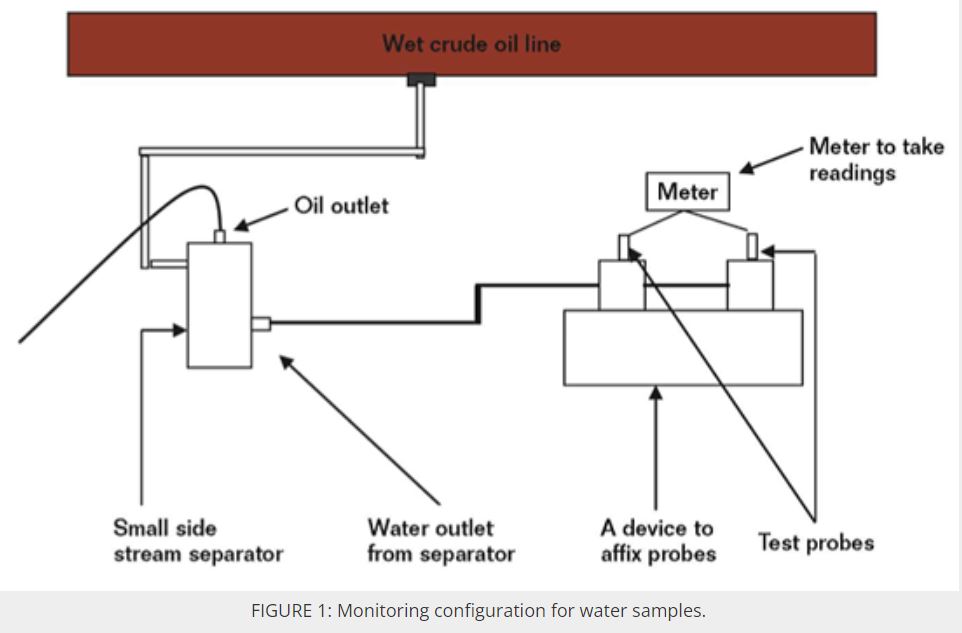
A side-stream arrangement can allow corrosion testing on fluid drawn directly from an operating pipeline while retaining more representative field conditions.
How the side-stream approach works
The article describes collecting fluid from a sampling point near the 6 o’clock position of a wet crude-oil pipeline and routing it through a small separator to obtain an oil-free water phase for testing.
The water outlet can then be connected to monitoring equipment equipped with linear polarization resistance (LPR) probes. Electrochemical techniques such as LPR—and, where appropriate, electrochemical impedance measurements—can provide information about the corrosivity of the water phase.
Because the sample is taken directly from the operating system, the approach can preserve conditions that may be difficult to reproduce after collecting a bottle sample and transporting it to a laboratory.
WHY FIELD-CONDITION TESTING CAN MATTER
Collected samples can change during handling and transport. Dissolved gases may escape, oxygen may enter, temperature and pressure may change, and phases may separate. Testing a representative side stream can reduce some of those differences, although the monitoring setup itself still needs to be designed and operated carefully.
Testing Inhibitor Performance Under Field Conditions
The same side-stream arrangement can also be used to evaluate inhibitor formulations under conditions that more closely resemble the operating pipeline.
This can be useful because inhibitor performance is highly dependent on the actual environment. Fluid chemistry, carbon dioxide, hydrogen sulfide, dissolved oxygen, temperature, pressure, flow behavior, water composition, and deposits may all influence corrosion behavior and treatment performance.
The article therefore cautions against assuming that a generic inhibitor formulation will perform equally well in every system. Treatment selection should account for the actual service environment and should be supported by appropriate monitoring and testing.
FIELD DATA THAT MAY HELP CHARACTERIZE THE SYSTEM
- Corrosion rate or electrochemical response
- Carbon dioxide (CO2)
- Hydrogen sulfide (H2S)
- Dissolved oxygen
- Dissolved and total iron
- Water chemistry
- Temperature and pressure
- Flow and production conditions
- Chemical-injection rate and continuity
Corrosion Coupons Still Have a Role
The original article also discusses corrosion coupons installed at representative locations within pipelines. Coupons can provide direct evidence of cumulative metal loss and surface condition over an exposure period.
Coupon holders may also be incorporated into sampling arrangements that feed a side-stream monitoring setup. However, pressurized access systems require appropriate procedures, equipment, and training.
The source specifically notes the need to avoid unintended coupon-holder displacement under pressure and to ensure that solids or debris do not block the sample-flow path.
NO SINGLE MONITOR TELLS THE WHOLE STORY
Corrosion monitoring is strongest when multiple data sources are interpreted together.
ER probes, LPR measurements, coupons, fluid chemistry, process data, inhibitor-injection records, inspection results, and operating history can each provide a different piece of the integrity picture.
From Reactive Inspection to More Proactive Corrosion Control
Traditional inspection remains essential for understanding actual asset condition. Real-time monitoring serves a different purpose: it can help operators identify changes in corrosivity, treatment delivery, and operating conditions between inspection intervals.
That creates an opportunity to move from simply discovering deterioration toward recognizing conditions that may increase corrosion risk and evaluating mitigation before damage becomes more extensive.
The goal is not to replace inspection with sensors. It is to combine monitoring, inspection, chemistry, process information, and corrosion expertise into a more responsive integrity-management program.
BOTTOM LINE
Real-time corrosion data are most valuable when they help connect changing field conditions with corrosion response—giving operators better information for evaluating chemical treatment, monitoring remote systems, and managing integrity over time.
TECHNICAL NOTE
Monitoring methods, inhibitor programs, sampling systems, probe locations, operating limits, and safety procedures should be selected for the specific asset and service conditions. Manufacturer instructions, project requirements, applicable standards, operating procedures, and qualified corrosion-engineering judgment should govern field implementation.
SOURCE
This article by Tata L.N. Murthy was originally published by Materials Performance Magazine. Republished with permission.
OIL & GAS CORROSION RESOURCES
Explore Corrosion Control for Oil and Gas Assets
AMPP’s oil and gas resources cover corrosion mechanisms, monitoring, inspection, chemical treatment, materials selection, coatings, cathodic protection, and asset integrity.
EXPLORE MORE
Corrosion Monitoring & Oil and Gas Resources
Oil & Gas Corrosion Reference Library →
Corrosion Reference Library →
AMPP Education →
AMPP Standards →
Materials Performance Magazine →

Have photos or videos from the field? Submit them to AMPP →