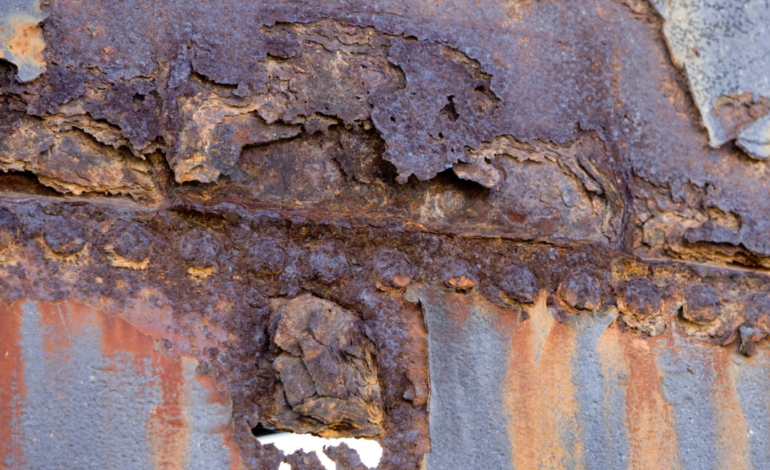
Examining Galvanic and Deposition Corrosion
GALVANIC CORROSION · ALUMINUM · COPPER · ARCHITECTURAL MATERIALS
Copper and aluminum can create a significant corrosion problem when they are placed in electrical contact and exposed to moisture—but direct metal-to-metal contact is not the only way copper can accelerate attack on aluminum.
This architectural case study examines two related mechanisms: galvanic corrosion caused by direct contact between copper and aluminum, and deposition corrosion that can occur when copper-containing runoff reaches an aluminum surface.
TWO DIFFERENT PATHS TO CORROSION
Copper + Aluminum + Electrical Contact + Electrolyte
↓
Galvanic Corrosion
OR
Copper-Containing Runoff + Aluminum
↓
Deposition Corrosion
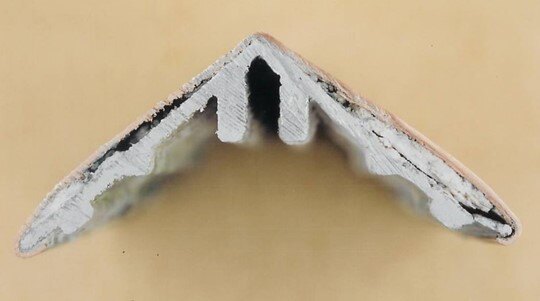
Cross-section through a dress cap. The aluminum angle is clad with copper sheet, with white corrosion products visible on the aluminum.
Galvanic Corrosion Between Copper and Aluminum
Corrosion professionals are familiar with the galvanic series, which ranks metals and alloys according to their electrochemical behavior in a given environment. When sufficiently dissimilar metals are electrically connected in the presence of an electrolyte, the more active member of the pair can experience accelerated corrosion.
In this case, the problem developed on a multi-story public building in Canada where copper architectural elements were combined with aluminum glazing components.
How the glazing system was constructed
Large panes of glass were secured to the building’s metal framework with aluminum pressure plates approximately 6 cm wide. Elastomer strips between the plates and the glass provided the sealing surface, while screws through the pressure plates held each pane in place.
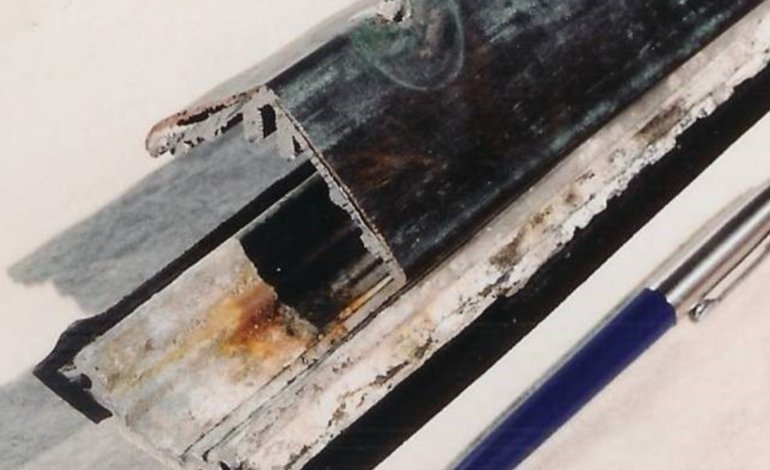
Decorative “dress caps” concealed the pressure plates and screws. These caps consisted of aluminum angle extrusions approximately 3.5 × 3.5 cm, with copper sheet mechanically wrapped around their longitudinal edges.
That construction placed copper and aluminum in direct contact. With moisture and rainwater providing an electrolyte, the combination created conditions favorable to galvanic attack of the aluminum.
WHY THE ALUMINUM WAS VULNERABLE
In the galvanic couple described in this case, aluminum was the more active material and experienced preferential attack, while the copper served as the more noble member of the pair.
The Corrosion Eventually Affected Building Performance
Significant corrosion developed on the aluminum components where the copper and aluminum were exposed to moisture. White aluminum corrosion products became visible around the affected areas.
According to the case study, the deterioration eventually contributed to leakage through the curtain-wall system and resulted in replacement of the glazing, pressure plates, and dress caps.
Separating the metals in the replacement design
The replacement design retained the desired copper appearance while changing the material beneath it. Instead of copper-clad aluminum angles, the new dress caps used glass fiber-reinforced plastic angles clad with copper sheet.
Using a nonmetallic substrate removed the direct copper-to-aluminum galvanic couple at the dress cap. However, that alone did not eliminate every possible pathway for copper-related attack.
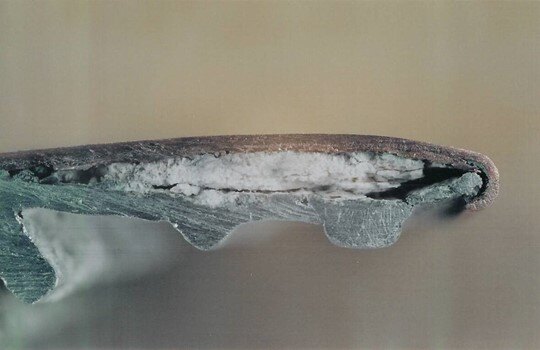
Close-up of the dress cap showing copper cladding and corrosion products formed on the underlying aluminum.
Deposition Corrosion: When the Metals Are Not Directly Touching
Copper can also contribute to corrosion of aluminum without the two structural components being in direct metal-to-metal contact.
Copper roofs, gutters, flashing, and architectural trim undergo some atmospheric corrosion. Water flowing across those surfaces can carry dissolved copper species. If that runoff reaches an aluminum component, copper may deposit onto the aluminum surface while aluminum dissolves.
This process is commonly referred to as deposition corrosion.
ENVIRONMENT MATTERS
Atmospheric exposure can make the runoff more aggressive
Urban contaminants and chloride-containing aerosols, including those associated with de-icing salts, can contribute to more corrosive exposure conditions on building exteriors.
For mixed-metal architectural systems, drainage paths and water movement can therefore matter almost as much as whether two components are physically touching.
The electrochemical process
In generalized form, deposition corrosion can be represented by a cathodic metal-deposition reaction coupled with anodic dissolution of another metal:
GENERALIZED REACTIONS
Ma+ + e− → Ma
Cathodic reaction: metal deposition
Mb → Mb+ + e−
Anodic reaction: metal dissolution
For the aluminum-copper system discussed in the article, the combined reaction was represented as:
2 Al + 3 Cu2+ → 2 Al3+ + 3 Cu ↓
In practical terms, copper deposits onto the aluminum while aluminum is oxidized and dissolves. The local copper deposits can then create additional cathodic sites on the aluminum surface.
SURFACE CONDITION CAN CHANGE THE RESPONSE
The original article notes that deposition corrosion may be inhibited when aluminum is protected by a sufficiently thick, continuous, and defect-free anodized layer. Actual performance depends on the condition of the protective layer and the service environment.
A Simple Experiment Demonstrates the Mechanism
To demonstrate deposition corrosion, aluminum strips approximately 1.25 mm thick were partially immersed in a copper sulfate solution at ambient temperature.
After several weeks, metallic copper had deposited onto the exposed aluminum. The strips also exhibited substantial thinning and perforation.
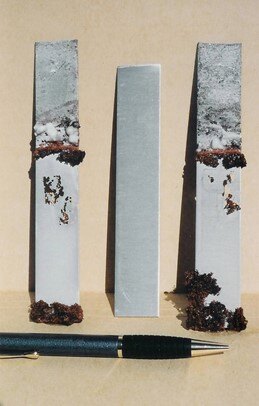
Two aluminum strips after several weeks of copper sulfate exposure show dark copper deposits, severe thinning, and perforation. The center strip was retained for comparison.
Why Drainage Design Matters in Mixed-Metal Systems
The building example highlights an important distinction. Preventing direct contact between dissimilar metals can address one galvanic-corrosion pathway, but it does not necessarily prevent contamination from one metal from reaching another.
Where copper roofs, trim, gutters, or flashing are installed above aluminum windows, pressure plates, door frames, or other components, the path taken by rainwater and runoff deserves careful consideration.
DESIGN FOR THE WATER PATH
Separate Incompatible Metals
+
Control Runoff
+
Limit Persistent Moisture
↓
Reduce Corrosion Risk
Practical Considerations for Copper and Aluminum on Buildings
- Avoid unnecessary direct electrical contact between copper and aluminum in exterior wet-service environments.
- Use suitable isolation or nonconductive materials where separation is part of the corrosion-control strategy.
- Consider the direction and collection of runoff from copper roofs, flashing, trim, and gutters.
- Use effective gutters, eaves-troughs, downspouts, and drainage paths so copper-bearing water is not directed onto vulnerable aluminum components.
- Consider environmental severity, including chlorides and urban atmospheric contaminants.
- Evaluate the condition and continuity of anodized or other protective surface treatments where they form part of the design.
- Inspect architectural joints and drainage details because retained moisture can sustain electrochemical corrosion processes.
The Same Chemistry Can Be Useful in Another Context
The underlying electrochemical reaction is not always undesirable. A related process has historically been used in extractive metallurgy to recover copper from copper-bearing solutions.
In one application, acidic solutions percolate through crushed copper-containing ore and dissolve copper. The resulting copper-bearing solution is then brought into contact with scrap iron.
Copper is deposited while iron enters solution:
Cu2+ (aq) + Fe (s) → Cu (s) + Fe2+ (aq)
This process is often referred to as cementation metallurgy. It illustrates that the same electrochemical tendencies responsible for damaging corrosion can also be deliberately used in a controlled industrial process.
Think Beyond Direct Metal Contact
The most obvious lesson from this case is that direct coupling of copper and aluminum on a wet building exterior can create a substantial galvanic-corrosion risk.
The less obvious lesson may be equally important: separating the structural metals does not necessarily solve the problem if runoff from the more noble metal can still carry dissolved species onto the more active one. Material selection, electrical isolation, drainage, surface protection, and environmental exposure must be considered together.
BOTTOM LINE
When copper and aluminum share the same exterior system, corrosion control should consider both direct galvanic contact and the path taken by copper-containing runoff.
EDITOR’S NOTE
This article first appeared in the September 2023 print issue of Materials Performance Magazine. Reprinted with permission.
References
1. M. Fontana, Corrosion Engineering, 3rd ed. (New York, NY: McGraw-Hill, 1986), p. 43.
2. “Corrosion of Aluminum and Aluminum Alloys,” Metals Handbook, 9th ed., vol. 13 (Metals Park, OH: ASM International, 1987), p. 589.
About the Author
Frank N. Smith
Frank N. Smith is a consultant based in Kingston, Ontario, Canada. His professional experience includes work in the chemicals, metals, and oil and gas industries in the United Kingdom, Canada, and Saudi Arabia, followed by consulting and university teaching in materials engineering, corrosion engineering, and failure analysis.
Smith holds a B.Sc. in chemistry and physics, an M.Sc. in electrochemistry, and a Ph.D. in metallurgical engineering. He is a life member of AMPP (NACE).
KEEP LEARNING
Explore More About Galvanic Corrosion
Learn more about electrochemical corrosion, material compatibility, cathodic protection, corrosion mechanisms, and methods for protecting assets in challenging environments.
EXPLORE MORE
Corrosion Fundamentals & Technical Resources
Corrosion Reference Library →
Cathodic Protection Resources →
Basic Corrosion Course →
AMPP Education →
Materials Performance Magazine →

Have photos or videos from the field? Submit them to AMPP →