What is Galvanic Corrosion?
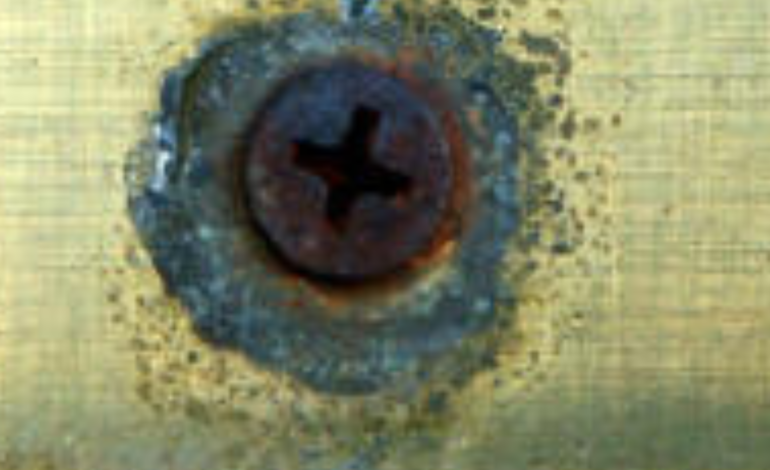
GALVANIC CORROSION · DISSIMILAR METALS
Galvanic corrosion occurs when dissimilar conductive materials are electrically connected in the presence of an electrolyte, causing one material to corrode faster while the other corrodes more slowly.
It is sometimes called dissimilar-metal corrosion. The term “electrolysis” is often used incorrectly to describe it. Galvanic corrosion is an electrochemical process driven by a difference in potential between the coupled materials.
AT A GLANCE
What is needed for galvanic corrosion?
- Two electrically connected conductive materials with different electrochemical behavior
- An electrolyte that allows ionic current to flow
- An electrical path between the materials
- A potential difference that drives the galvanic current
How Galvanic Corrosion Works
When two dissimilar materials form a galvanic couple, one behaves more anodically and the other more cathodically under the conditions present.
The anodic material experiences an increased corrosion rate compared with its uncoupled condition. The cathodic material typically experiences a reduced corrosion rate.
The effect depends on the materials involved and the environment. Either material may also be capable of corroding on its own, but electrical coupling can change the rate at which corrosion occurs.
THE GALVANIC COUPLE
Less Noble Material = Anode
↓
Accelerated Metal Loss
+
More Noble Material = Cathode
↓
Reduced Corrosion Rate
IMPORTANT
“Anode” and “cathode” describe electrochemical behavior in a specific system. The same material can behave differently when paired with a different material or exposed to a different environment.
The Driving Force: Electrical Potential Difference
The driving force behind galvanic corrosion is the difference in electrochemical potential between materials in a particular environment.
When an electrical connection and an electrolyte are present, that potential difference can drive current through the galvanic couple. The resulting current affects the corrosion behavior of both materials.
From Galvani and Volta to Modern Corrosion Control
The electrochemical principles behind galvanic action were explored in the late eighteenth century through the work of Luigi Galvani and Alessandro Volta.
Volta’s development of the voltaic pile in 1800 demonstrated that combinations of dissimilar metals and an electrolyte could generate a sustained electrical current. That discovery became foundational to electrochemistry and modern batteries.
In the nineteenth century, the same basic principle was deliberately applied to corrosion control. Work by Humphry Davy and Michael Faraday helped establish the electrochemical foundations of cathodic protection.
Turning Galvanic Action Into Protection
Galvanic action is not always undesirable. It can also be intentionally engineered to protect a structure.
In galvanic cathodic protection systems, a more active metal is electrically connected to the structure being protected. The more active material acts as the sacrificial anode and preferentially corrodes.
Materials such as zinc, magnesium, and aluminum alloys are commonly used as galvanic anodes in appropriate applications.
THE SAME PRINCIPLE, USED ON PURPOSE
Galvanic corrosion can damage an asset—or protect one.
The difference is whether the electrochemical relationship is uncontrolled or intentionally designed as part of a cathodic protection system.
What Does “Noble” Mean?
In a galvanic couple, the material that behaves more actively tends to become the anode, while the material behaving more nobly tends to act as the cathode.
The relative behavior of materials can be evaluated through corrosion-potential measurements. A galvanic series ranks materials according to their measured electrochemical behavior in a specific environment.
The environment matters. A galvanic series developed for seawater, for example, should not automatically be assumed to describe material behavior in every other electrolyte or service condition.
A GALVANIC SERIES IS ENVIRONMENT-SPECIFIC
Material rankings can shift with changes in electrolyte, temperature, surface condition, aeration, films, and other service conditions. Use data applicable to the actual environment.
Why Anode-to-Cathode Area Ratio Matters
The relative exposed areas of the anodic and cathodic materials can strongly influence galvanic corrosion severity.
A particularly unfavorable configuration is a small anodic area electrically connected to a much larger cathodic area. In that arrangement, galvanic current can be concentrated on the smaller anodic surface.
That current concentration can contribute to rapid localized metal loss at the anode.
HIGHER CONCERN
Small Anode + Large Cathode
Galvanic current can be concentrated on a relatively small anodic area, potentially increasing the rate of localized metal loss.
DESIGN CONSIDERATION
Consider the Whole Couple
Material compatibility, exposed area, coatings, geometry, environment, electrical continuity, and drainage can all affect galvanic behavior.
How to Reduce Galvanic Corrosion Risk
The most effective approach is often to address galvanic compatibility during design rather than waiting for accelerated corrosion to appear in service.
DESIGN STRATEGIES MAY INCLUDE
- Selecting materials with compatible electrochemical behavior for the service environment
- Electrically isolating dissimilar materials where appropriate
- Controlling exposure to the electrolyte
- Using protective coatings appropriately
- Considering the relative anodic and cathodic surface areas
- Designing drainage and detailing to limit persistent moisture
- Using cathodic protection where technically appropriate
BE CAREFUL WITH COATING DESIGN
A coating can change the effective anode-to-cathode area ratio.
If a coating system leaves a small exposed anodic area coupled to a much larger cathodic surface, localized attack may become more severe. Coating strategy should therefore consider the entire galvanic couple.
Galvanic Effects Can Occur at Different Scales
Galvanic corrosion can occur on a macroscopic scale, such as when two visibly different metals are connected in an electrolyte.
Galvanic effects can also occur on a microscopic scale within a material when different phases, inclusions, or microstructural features have different electrochemical behavior.
Galvanic Principles in Corrosion Monitoring
The electrochemical behavior behind galvanic coupling is also used in corrosion science and monitoring. Measurements of potential and galvanic current can provide information about electrochemical interactions and corrosion conditions in selected systems.
Designing With Galvanic Corrosion in Mind
Dissimilar metals do not automatically create a severe corrosion problem. Galvanic behavior depends on the materials, electrolyte, electrical connection, exposed areas, coatings, geometry, and service conditions.
Understanding those relationships early makes it easier to select compatible materials, isolate problematic couples, control exposure, and design corrosion protection into the asset before accelerated metal loss develops.
BOTTOM LINE
Galvanic corrosion is driven by the electrochemical relationship between connected materials and their environment. Manage that relationship, and you can often manage the corrosion risk.
KEEP LEARNING
Explore Corrosion and Cathodic Protection Resources
Learn more about electrochemical corrosion, galvanic relationships, cathodic protection, and practical corrosion-control methods.
EXPLORE MORE
Corrosion Control Resources
Cathodic Protection →
Corrosion Reference Library →
AMPP Education →
AMPP Standards →

Have photos or videos from the field? Submit them to AMPP →