Did You Know? The DoD’s Battle Against Corrosion and Its Impact on National Security
DEFENSE · CORROSION CONTROL · MISSION READINESS
Corrosion is more than a maintenance issue for the U.S. Department of Defense. It can affect asset availability, safety, lifecycle cost, and the ability to keep mission-critical systems ready for use.
Military assets operate in demanding environments—from saltwater and high humidity to temperature extremes, chemicals, abrasion, and long service lives. Ships, aircraft, ground vehicles, weapons systems, utilities, and facilities can all be affected by materials degradation, making corrosion prevention and control an important part of defense asset management.
AT A GLANCE
Why corrosion matters to defense
- Readiness: Corrosion can take equipment out of service or create additional maintenance requirements.
- Safety: Materials degradation can affect the integrity of equipment, structures, and systems.
- Lifecycle cost: Prevention, inspection, repair, replacement, and downtime all have financial consequences.
- Asset availability: Effective corrosion control can support longer service life and more predictable maintenance.
- National defense: Reliable materials performance helps sustain mission-capable assets and infrastructure.
The Cost of Corrosion Across the DoD
The scale of the Department of Defense means even seemingly routine deterioration can become a major lifecycle-management issue. A DoD-contracted study reported that corrosion had a $20.6 billion cost impact in fiscal year 2016.
That figure should be understood as a historical benchmark rather than a current annual estimate, but it demonstrates the scale at which corrosion can affect military maintenance and asset-management programs.
THE SCALE OF THE CHALLENGE
$20.6 BILLION
Reported corrosion cost impact to the U.S. Department of Defense in fiscal year 2016, based on a DoD-contracted study.
Why Marine Environments Are Especially Demanding
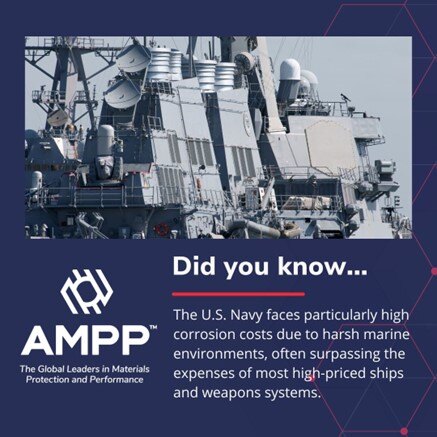
Naval assets face some of the most aggressive environments in defense. Saltwater, marine atmospheres, humidity, splash zones, condensation, immersion, weather exposure, and mechanical wear can all contribute to corrosion risk.
Aircraft carriers, submarines, support vessels, shore facilities, and equipment may require coatings, cathodic protection, materials selection, inspection, maintenance, and other corrosion-control measures suited to their specific service conditions.
MARINE CORROSION
The sea creates a demanding corrosion environment
Saltwater and humid marine atmospheres can increase corrosion risk, which is why naval readiness depends on a combination of design, coatings, inspection, maintenance, and other materials-protection strategies.
Corrosion and Mission Readiness
The impact of corrosion is not limited to the cost of replacing damaged metal or repainting an asset. Degradation can create inspections, repairs, maintenance delays, unscheduled downtime, reduced availability, and safety concerns.
For military organizations, those effects can directly influence readiness. A system undergoing unexpected corrosion repair is a system that may not be available for training, deployment, or operational use.
CORROSION CAN BECOME A READINESS ISSUE
Materials Degradation
↓
Inspection or Repair
↓
Asset Downtime
↓
Potential Readiness Impact
The DoD Office of Corrosion Policy and Oversight
The Department of Defense established the Office of Corrosion Policy and Oversight (CPO) to coordinate corrosion-prevention and control efforts across military equipment and infrastructure.
Its responsibilities include developing long-term strategy, coordinating programs, supporting testing and certification criteria, advancing research and development, and helping transition corrosion-prevention technologies into operational systems.
FUNDING CONTEXT
Congress increased FY25 authorization for the CPO office to $7.1 million.
AMPP reported in December 2024 that the Fiscal Year 2025 National Defense Authorization Act increased authorized funding for the DoD Corrosion Policy and Oversight Office to $7.1 million, approximately $4.5 million above the level initially proposed. Authorization and actual appropriations are distinct parts of the federal funding process.
HISTORICAL COST BENCHMARK
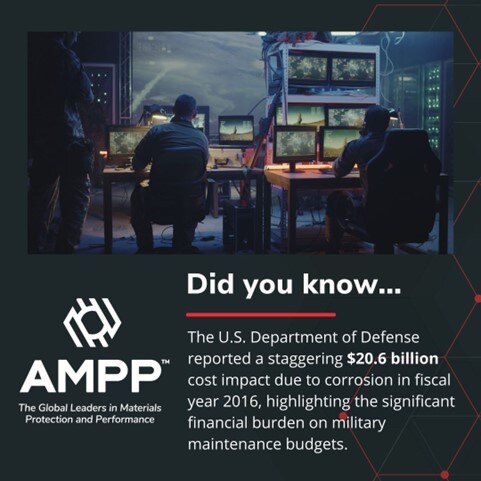
$20.6 billion in FY2016
A DoD-contracted study reported a $20.6 billion corrosion cost impact for fiscal year 2016. The figure demonstrates the scale of the issue but should not be presented as a current-year estimate.
Corrosion Control Is a Lifecycle Strategy
Managing corrosion effectively requires more than repairing damage after it appears. Prevention and control can begin during design and continue throughout operation, inspection, maintenance, repair, and eventual replacement.
The appropriate strategy depends on the asset and environment, but defense corrosion programs can draw on a range of materials-protection approaches.
DESIGN
Design for the environment
Consider materials, geometry, drainage, accessibility, service conditions, and corrosion-control requirements before an asset enters service.
PROTECTION
Use appropriate corrosion controls
Protective coatings, cathodic protection, corrosion-resistant materials, inhibitors, and environmental controls may be appropriate depending on the system.
INSPECTION
Find deterioration before it becomes critical
Inspection, monitoring, testing, and condition assessment can help identify developing problems and inform maintenance decisions.
MANAGEMENT
Use lifecycle information to prioritize work
Maintenance history, inspection findings, failure data, operating conditions, and consequence can help determine where resources are most needed.
THINK IN LIFECYCLE TERMS
Prevention + Inspection + Maintenance + Corrosion Management
↓
Improved Asset Reliability and Readiness
AMPP and the Defense Corrosion Community
AMPP has worked with the Department of Defense corrosion community for more than two decades, supporting efforts related to training, standards, technical resources, coatings, corrosion prevention, and workforce development.
AMPP also engages in government affairs related to corrosion policy and has advocated for continued federal support of the CPO office and broader materials-protection initiatives.
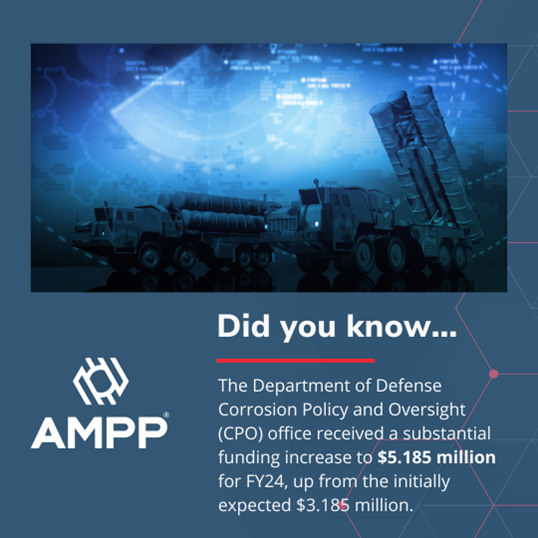
HISTORICAL FY24 CONTEXT
The funding picture has continued to evolve
This original 2024 graphic referenced an FY24 funding increase for the CPO office. Subsequent congressional action increased FY25 authorization to $7.1 million, so the older figure should be read as historical context rather than the current funding level.
Corrosion Prevention Supports More Than Maintenance
For the Department of Defense, corrosion control connects engineering, maintenance, safety, lifecycle cost, and operational availability. Preventing deterioration where practical—and identifying it early when it does occur—can help reduce avoidable disruption and preserve the performance of critical assets.
The objective is not to eliminate every instance of corrosion. It is to manage corrosion risk deliberately across the asset lifecycle so defense organizations can make better-informed decisions about prevention, inspection, maintenance, and repair.
BOTTOM LINE
For defense assets, effective corrosion management is part of sustaining readiness—not simply repairing rust.
DEFENSE & CORROSION
Explore AMPP Defense Resources
Learn more about corrosion prevention, coatings, training, standards, and materials-protection resources supporting defense assets and mission readiness.
EXPLORE MORE
Defense & Materials Protection Resources
Safeguarding Mission-Critical Defense Assets →
Department of Defense Corrosion Resources →
AMPP Education →
AMPP Standards →
AMPP Government Affairs →

Have photos or videos from the field? Submit them to AMPP →