Corrosion Management and Cost Optimization
OIL & GAS · CORROSION MANAGEMENT
Optimizing corrosion costs is not simply about spending less. It is about balancing corrosion-control, inspection, monitoring, and management costs with the risk and potential cost of corrosion failure.
For oil and gas assets, that balance begins during design and continues throughout operation. Decisions about materials, corrosion allowance, chemical treatment, inspection, monitoring, risk assessment, and corrosion management can all influence lifecycle cost and asset integrity.
THE CORE PRINCIPLE
Cost optimization is not the same as cost reduction.
Reducing corrosion-control spending without understanding the resulting risk can create larger costs later. Effective optimization seeks the appropriate level of prevention, monitoring, inspection, and management without compromising integrity performance.
AT A GLANCE
A lifecycle approach to corrosion cost
- Corrosion costs can occur before or after failure.
- Pre-failure spending includes both corrosion engineering and broader integrity-management activities.
- Some of the most important cost decisions are made during asset design.
- Both overdesign and underdesign can create unnecessary lifecycle costs.
- Inspection and monitoring should reflect risk and reliable asset information.
- Reducing integrity measures without evaluating the consequences is not true cost optimization.
Understanding Corrosion Costs
One way to understand corrosion-related spending is to use the point of asset failure as a dividing line. Under the framework presented in the original article, corrosion costs fall into two broad categories: pre-failure costs and post-failure costs.
This distinction helps organizations see corrosion spending as part of an asset’s lifecycle rather than as a collection of isolated maintenance expenses.
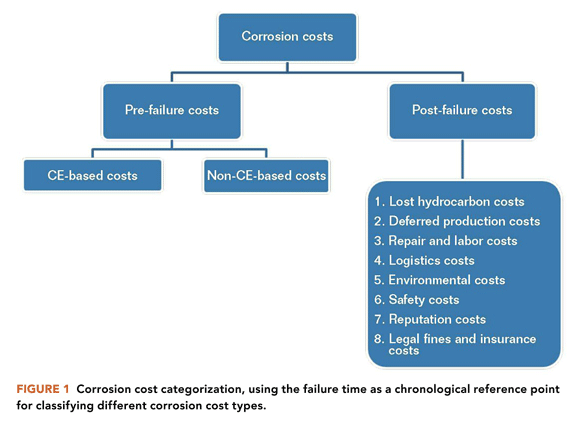
Figure 1. Corrosion cost categorization using asset failure as the chronological reference point.
PRE-FAILURE COSTS
Investing before failure
These costs support corrosion prevention, control, monitoring, inspection, risk assessment, and management before a corrosion-related failure occurs.
POST-FAILURE COSTS
Responding after failure
These can include repair and labor, lost product, deferred production, operational impacts, and other consequences associated with a corrosion-related failure.
Two Types of Pre-Failure Corrosion Costs
The framework further separates pre-failure costs into corrosion engineering-based (CE-based) and non-corrosion engineering-based (non-CE-based) costs.
CORROSION ENGINEERING-BASED
Technical decisions that control corrosion
- Design: including corrosion allowance
- Materials selection: including metallic and non-metallic options
- Environmental control: including corrosion inhibitor or other chemical treatment
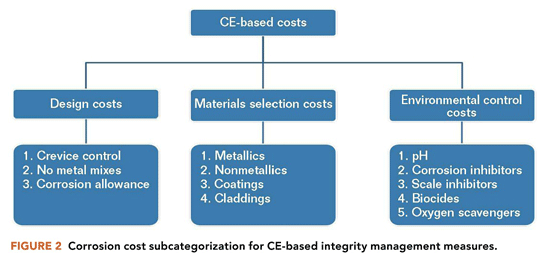
Figure 2. Corrosion engineering-based cost categories and influencing variables.
NON-CORROSION ENGINEERING-BASED
Integrity-management activities that support the technical program
- Inspection
- Corrosion monitoring and fluid sampling
- Management systems, procedures, documentation, databases, and communication
- Failure risk assessment activities
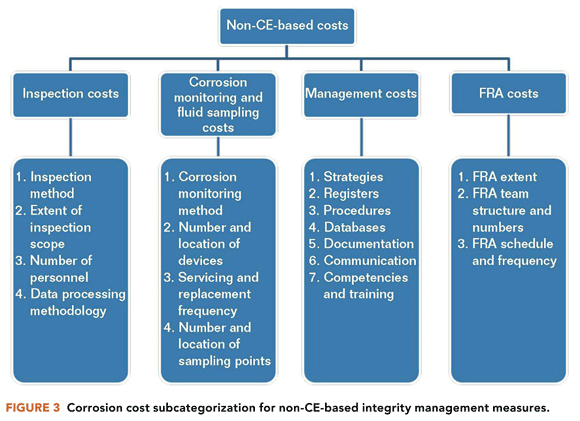
Figure 3. Variables influencing non-corrosion engineering-based integrity-management costs.
What Does Corrosion Cost Optimization Mean?
In this framework, corrosion cost optimization means managing both CE-based and non-CE-based integrity measures so that corrosion failures are minimized while the effectiveness of those measures is maintained.
The objective is therefore not to minimize every individual line item. It is to manage lifecycle corrosion costs while maintaining appropriate corrosion-control and integrity-management performance.
THINK IN LIFECYCLE TERMS
Appropriate Prevention + Effective Monitoring + Risk-Based Inspection + Strong Management
↓
Better Control of Lifecycle Corrosion Risk & Cost
Corrosion Management and Cost Optimization
Corrosion management and corrosion cost optimization are closely connected because both involve the technical and organizational measures used to manage corrosion throughout an asset’s lifecycle.
A well-implemented corrosion management program can help organizations make better decisions about where corrosion-control resources are needed, where spending may be excessive, and where reductions could create unacceptable risk.
Cost Optimization Starts During Design
A significant portion of corrosion-related lifecycle cost can be influenced before an asset enters service. For upstream oil and gas assets and associated pipelines, the original article emphasizes the importance of representative fluid sampling and accurate analysis when assessing corrosivity during design.
If corrosivity is incorrectly characterized, the resulting corrosion-control strategy may be either unnecessarily conservative or insufficient for the actual operating environment.
OVERDESIGN
More protection than conditions require
Overestimating corrosivity may contribute to unnecessary costs through measures such as:
- Excessive corrosion allowance
- Unnecessary use of higher-cost alloys
- Additional linings or claddings
- Higher-than-needed chemical treatment
UNDERDESIGN
Less protection than conditions require
Underestimating corrosivity may reduce initial spending while creating later costs through:
- Premature material replacement
- Changes to corrosion-control measures
- Higher chemical-treatment requirements
- Greater likelihood of corrosion-related failures
THE DESIGN GOAL
Avoid both overdesign and underdesign. Corrosion-control decisions should be based on reliable information about the asset, environment, process conditions, materials, and expected operating conditions.
Optimizing Inspection, Monitoring, and Management Costs
Technical corrosion-control measures are only part of the cost equation. Inspection, monitoring, documentation, communication, competency, and risk assessment also influence the effectiveness of an integrity-management program.
01 · INSPECTION
Match inspection effort to risk
An unnecessarily conservative inspection scope can increase cost without providing proportional value. Too little inspection, however, may leave higher-risk locations or active deterioration undetected. Risk-based planning can help balance coverage, frequency, and resources.
02 · MONITORING & SAMPLING
Collect enough information to make sound decisions
Monitoring and fluid-sampling programs should provide useful information about corrosion conditions without generating unnecessary activity. Insufficient monitoring can also create risk if significant changes in corrosion conditions go undetected.
03 · MANAGEMENT SYSTEMS
Do not overlook documentation and communication
Registers, databases, procedures, strategies, communication, documentation, and personnel competency may not look like traditional corrosion-control measures, but they help organizations turn technical information into consistent asset-management decisions.
04 · FAILURE RISK ASSESSMENT
Use reliable inputs
Failure risk assessments are most useful when they are properly planned and based on reliable asset and corrosion information. Poor inputs can undermine the decisions that follow.
The Cost-Cutting Trap
One of the most important distinctions in corrosion cost optimization is the difference between removing unnecessary expenditure and simply reducing an integrity-management measure because it costs money.
BEFORE CUTTING COSTS, ASSESS THE CONSEQUENCES
A smaller corrosion budget does not necessarily mean a lower corrosion cost.
Reducing inspection scope, chemical treatment, training, monitoring, documentation, communication, or other integrity measures without evaluating the resulting risk may create short-term savings while increasing long-term exposure.
The question should not be, “Where can we spend less?” It should be, “Where can we optimize resources without compromising corrosion-control performance?”
A Practical Corrosion Cost Optimization Framework
STEP 1
Identify the corrosion threats
Understand the materials, environment, process conditions, damage mechanisms, and operating conditions that can influence corrosion.
STEP 2
Understand current controls and costs
Map the technical controls, inspection, monitoring, sampling, management systems, and risk-assessment activities currently being used.
STEP 3
Evaluate risk before changing the program
Determine what could happen if a control is reduced, removed, increased, or replaced.
STEP 4
Optimize—not simply minimize
Look for the level of corrosion-control and integrity-management activity appropriate to the asset’s actual risk and operating conditions.
STEP 5
Reassess as conditions change
Corrosion conditions, operating parameters, asset age, inspection findings, and risk can change over time. Cost optimization should therefore be an ongoing management process.
Better Corrosion Management Can Support Better Cost Decisions
Corrosion cost optimization begins with understanding where corrosion-related costs originate, what influences them, and how technical and organizational decisions affect asset integrity over time.
For oil and gas assets, the strongest approach is not to spend as little as possible on corrosion. It is to use accurate information, appropriate engineering, risk-based integrity management, and effective corrosion management to make better lifecycle decisions.
BOTTOM LINE
The goal is not the lowest corrosion-control budget. The goal is the right corrosion-control strategy for the asset, its risks, and its lifecycle.
SOURCE & REFERENCE
Reference: A. Morshed, “The Evolution of the Corrosion Management Concept,” Materials Performance, Vol. 52, No. 8 (2013), p. 66.
This article by Ali Morshed first appeared on MaterialsPerformance.com on May 4, 2020. Republished by permission.
KEEP LEARNING
Explore Corrosion Management Resources
Explore technical information, education, standards, and industry resources for managing corrosion and protecting critical assets.
EXPLORE MORE
Corrosion & Asset Protection Resources
Corrosion Reference Library →
AMPP Education →
AMPP Standards →
Materials Performance →

Have photos or videos from the field? Submit them to AMPP →