Sensors Can Predict Corrosive Conditions in Military Aircraft
DEFENSE AVIATION · CORROSION MONITORING · AIRCRAFT · CONDITION-BASED MAINTENANCE
Aircraft corrosion is not always visible from the outside. Some of the most important environments exist behind panels, beneath floorboards, around fasteners, and inside compartments that are difficult to reach during routine inspection.
Research conducted for U.S. military aviation explored whether small corrosion-monitoring sensor nodes could help maintainers understand those hidden environments and make inspection decisions based on actual corrosivity conditions rather than relying only on fixed schedules.
THE MAINTENANCE CHALLENGE
Corrosion Can Develop in Hidden Areas
↓
Manual Access Can Be Labor-Intensive
↓
Scheduled Inspection May Miss Developing Conditions
↓
Sensors Could Add Condition Information Between Inspections
Why Corrosion Matters to Military Aircraft
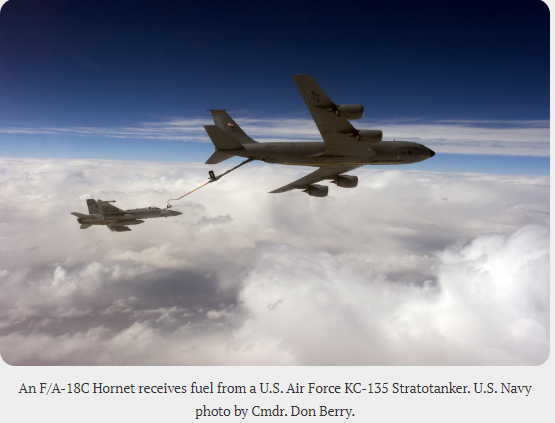
The U.S. Department of Defense operates aircraft in widely varying environments—from marine and coastal locations to hot, humid, cold, and salt-laden regions.
Corrosion can affect airframe structures, electrical wiring and interconnection systems, avionics, fasteners, and other components. Beyond repair cost, corrosion can also increase aircraft downtime and reduce operational availability.
The historical source cited substantial corrosion-related maintenance costs across U.S. military aviation, illustrating why prevention, early detection, and efficient inspection have long been important readiness issues.
CORROSION IS ALSO AN AVAILABILITY PROBLEM
For operational assets, corrosion cost is not limited to materials and labor. Inspection time, disassembly, repair, component replacement, and aircraft downtime can all affect readiness.
Why Manual Aircraft Inspection Can Be Difficult
Many aircraft corrosion-prone areas can be located behind access panels, floorboards, seals, and other structures that require disassembly before inspection.
One of the biggest challenges in airframe inspection is simply reaching the surface that needs to be examined.
Maintenance personnel may need to open panels, break seals, remove floorboards, or disassemble other components before visual inspection or nondestructive evaluation can begin.
Even after access is gained, some corrosion may remain difficult to detect because damage can develop beneath coatings, between overlapping components, around fasteners, or inside other concealed geometries.
INSPECTION ACCESS HAS A COST
Open Panels
+
Remove Flooring or Components
+
Break & Restore Seals
↓
Time, Labor & Aircraft Downtime
Inspection Can Sometimes Disturb the Protective Environment
The source also raises an important paradox: repeatedly opening sealed areas for inspection may itself change the environment inside the aircraft.
Breaking seals and opening compartments can potentially expose previously protected areas to humidity, salts, or other environmental contaminants. That makes it valuable to know whether a hidden area actually requires access before disturbing it.
THE GOAL IS NOT TO ELIMINATE INSPECTION
Condition monitoring can help determine where and when human inspection is most valuable. It does not replace the need for qualified inspection when the condition of the structure must be directly evaluated.
Aircraft Are Vulnerable to Several Forms of Localized Corrosion
Aircraft structures use lightweight materials and complex geometries that can be susceptible to several corrosion mechanisms.
CORROSION MECHANISMS DISCUSSED IN THE CASE STUDY
- Surface corrosion from atmospheric exposure
- Pitting corrosion that can create localized penetration and stress concentration
- Crevice corrosion in shielded gaps and interfaces
- Exfoliation corrosion associated with susceptible aluminum microstructures
- Stress corrosion cracking under the combined influence of tensile stress and environment
- Corrosion fatigue involving cyclic loading and a corrosive environment
- Galvanic corrosion where dissimilar metals such as aluminum and steel fasteners interact in the presence of an electrolyte
An Aircraft Contains Many Different Microclimates
Humidity, temperature, salts, drainage, airflow, and compartment geometry can create different corrosion environments within the same aircraft.
The corrosive environment inside an aircraft is not necessarily uniform.
Temperature, relative humidity, time of wetness, airborne salts, drainage, airflow, contamination, and surrounding materials can vary significantly between compartments.
These localized environments—or microclimates—can explain why one region of an airframe experiences corrosion while another region exposed to the same outside weather remains relatively unaffected.
OUTSIDE WEATHER ≠ INTERNAL AIRFRAME CONDITIONS
Ambient Environment
≠
Condition Inside Every Aircraft Compartment
Measuring the Environment Where Corrosion Actually Happens
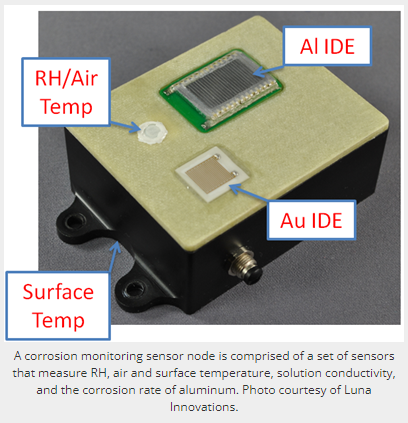
As part of a Small Business Innovation Research program for the Naval Air Systems Command, Luna Innovations developed a small multimodal corrosion-sensor system intended to monitor conditions within aircraft microclimates.
The historical system combined several measurements in a compact node rather than relying on a single environmental parameter.
THE SENSOR NODE MEASURED
- Relative humidity
- Air temperature
- Surface temperature
- Conductivity of moisture or condensate on the sensor
- Corrosion rate of aluminum
- Time-stamped environmental and corrosion data
The collected data could be stored onboard and later transferred for graphical analysis, giving maintainers both current readings and a history of environmental conditions between inspections.
From Sensor Data to Corrosivity Classification
The system was designed to combine sensor output with atmospheric-corrosivity concepts based on ISO 9223.
Rather than presenting maintainers only with raw temperature or humidity readings, the system could associate measured conditions with an environmental severity classification.
That created the possibility of turning environmental measurements into more actionable maintenance information.
FROM DATA TO MAINTENANCE DECISIONS
Measure the Microclimate
↓
Estimate Environmental Severity
↓
Identify Areas of Higher Corrosion Risk
↓
Prioritize Inspection & Maintenance
Installing Sensors at Known Corrosion Hotspots
Aircraft maintenance teams often already know which areas of a particular platform tend to develop corrosion.
Examples discussed in the source include locations beneath helicopter floorboards and around tail-boom structures—areas that may be corrosion-prone yet inconvenient to inspect repeatedly.
Placing a sensor node in one of these hotspots could provide environmental and corrosion information without requiring the area to be opened each time maintainers wanted to understand its condition.
PUT THE SENSOR WHERE THE QUESTION IS
A corrosion-monitoring system is most useful when sensor placement is tied to known mechanisms, vulnerable materials, trapped moisture, difficult access, or a documented history of damage.
Building a Corrosion History Between Inspections
Another advantage of continuous or periodic monitoring is that it can capture conditions that occur between scheduled inspections.
A short period of unusually high humidity, salt contamination, condensation, or elevated corrosion rate might otherwise disappear before the next maintenance interval.
Time-stamped monitoring data create a history that can help maintainers connect unusual corrosion activity with operating conditions, location, weather, or other events.
Testing Showed Why Internal Measurements Matter
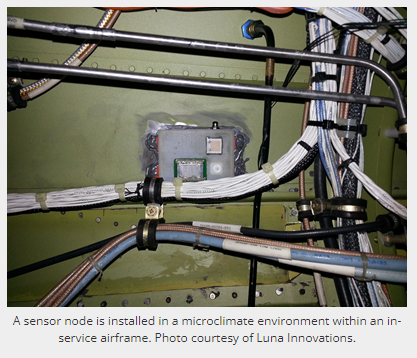
A sensor node was installed within an aircraft airframe to compare internal microclimate conditions with the surrounding ambient environment.
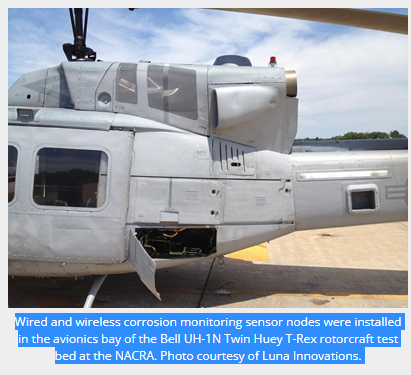
During a five-month test at Naval Air Station Patuxent River, sensor nodes were installed in the avionics bay of a Bell UH-1N rotorcraft test bed.
Researchers compared measurements from inside the aircraft with ambient weather-station data from the same time period.
The measured relative humidity inside the airframe was often significantly lower than ambient relative humidity—demonstrating that external weather data alone did not fully describe the actual environment around internal aircraft structures.
ONE OF THE KEY FINDINGS
Knowing the weather outside the aircraft did not necessarily reveal the environment inside the airframe.
For corrosion monitoring, measurements taken close to the vulnerable material may provide more useful information than relying only on ambient environmental data.
Seasonal Trends Appeared in the Corrosion Data
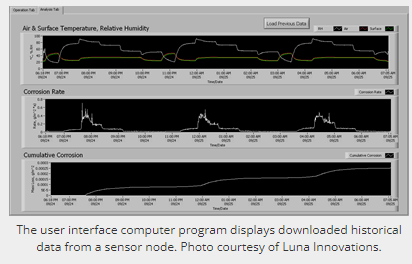
The research observed seasonal changes in humidity, condensate conductivity, and measured corrosion activity.
The testing also revealed seasonal trends.
During winter months, the monitored environment showed lower relative humidity, lower condensate conductivity, and lower corrosion rates than during warmer periods.
The researchers suggested that information like this could eventually help maintenance planners understand when inspection frequency might reasonably change with environmental severity.
CONDITION DATA CAN SUPPORT — NOT AUTOMATICALLY CHANGE — INSPECTION INTERVALS
Any decision to change an inspection interval should still follow the applicable maintenance program, engineering requirements, airworthiness criteria, approved procedures, and qualified technical judgment.
Toward Condition-Based Corrosion Maintenance
The larger idea behind the project was to move beyond inspection that is triggered only by elapsed time.
If maintainers can understand the environmental severity and corrosion history of specific aircraft locations, inspection resources can potentially be focused where the evidence indicates they are most needed.
That is the foundation of condition-based maintenance: use real asset information to support maintenance decisions rather than treating every location as if it experiences the same environment and deterioration rate.
CONDITION-BASED CORROSION MANAGEMENT
Monitor the Environment
↓
Track Corrosion Activity Over Time
↓
Identify Higher-Risk Locations
↓
Target Inspection & Maintenance
↓
Improve Availability & Corrosion Control
What This Research Still Teaches
Although the sensor hardware described in this research belongs to an earlier generation of corrosion-monitoring technology, the underlying maintenance principles remain useful.
KEY TAKEAWAYS
- Corrosion conditions inside an aircraft may differ substantially from ambient weather conditions.
- Hidden corrosion hotspots can be expensive and disruptive to inspect repeatedly.
- Humidity alone does not fully describe corrosion risk.
- Combining environmental and corrosion measurements can provide more useful context.
- Monitoring can preserve a history of conditions between inspections.
- Sensor placement should be driven by known vulnerabilities and corrosion mechanisms.
- Condition data can help prioritize inspection but does not replace engineering judgment or required inspection.
- The ultimate goal is better corrosion control with less unnecessary disruption to the aircraft.
BOTTOM LINE
Corrosion monitoring can help aircraft maintainers understand what is happening in difficult-to-access microclimates between inspections, making it possible to focus maintenance attention where changing environmental conditions and corrosion activity indicate the greatest need.
HISTORICAL RESEARCH NOTE
This article describes historical U.S. military corrosion research and sensor technology. Sensor systems, ISO references, military maintenance procedures, aircraft inspection requirements, corrosion-cost estimates, and condition-based maintenance practices may have changed. Current aviation maintenance and corrosion-control decisions should follow current approved technical data, applicable standards, engineering requirements, and airworthiness procedures.
SOURCE
This article was originally published by Materials Performance Magazine and is republished with permission.
The research discussed work by Luna Innovations conducted through a Small Business Innovation Research program for the Naval Air Systems Command and included testing at Naval Air Station Patuxent River.
DEFENSE CORROSION RESOURCES
Explore Corrosion Control for Defense Assets
AMPP resources cover corrosion monitoring, inspection, coatings, materials protection, maintenance, and corrosion-control practices for defense and aerospace assets.

Have photos or videos from the field? Submit them to AMPP →