Remedial Measures for Reinforced Concrete Structures
CONCRETE · REINFORCING STEEL · CORROSION CONTROL
Reinforcing steel embedded in concrete is normally protected by the concrete’s alkaline environment. But when aggressive ions such as chlorides reach the steel in sufficient concentration, that protection can break down and corrosion can begin.
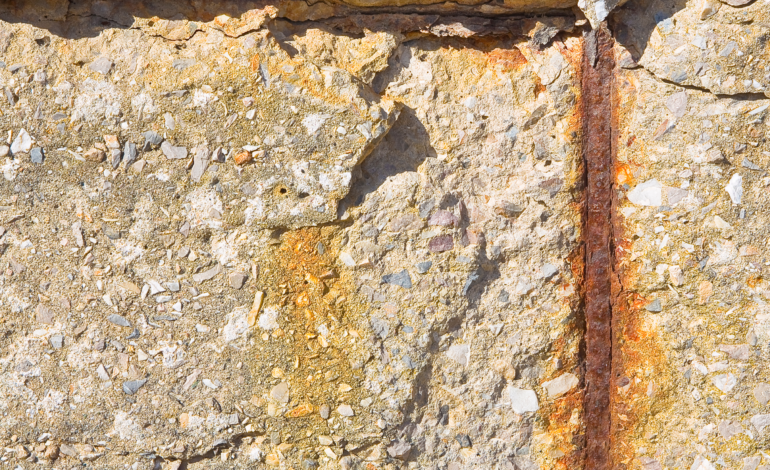
As reinforcing steel corrodes, metal is lost and corrosion products form around the rebar. Because those corrosion products occupy more volume than the original steel, they can create internal pressure that contributes to cracking, delamination, and spalling of the surrounding concrete.
Image note: The increased volume of corrosion products compared with the original steel can contribute to cracking and spalling of surrounding concrete. Photo by Getty Images.
How Reinforcing Steel Corrosion Develops
New concrete typically has a high-pH environment that helps passivate carbon steel reinforcement through formation of a thin, stable oxide layer on the steel surface.
Over time, aggressive species can move through the concrete pore structure. Chlorides from marine exposure, deicing salts, or other external sources are a common concern.
When conditions at the steel surface become sufficiently aggressive, the passive layer can destabilize and corrosion can initiate. Continued corrosion may reduce steel cross-section and contribute to damage in the surrounding concrete.
THE DETERIORATION PATH
Aggressive Ions Reach the Rebar
↓
Passive Protection Breaks Down
↓
Steel Corrodes
↓
Cracking, Delamination, Spalling, and Section Loss May Develop
New Structures and Existing Structures Require Different Strategies
A critical distinction in corrosion control is whether the structure is still being designed or has already been built and exposed to service conditions.
New construction offers more opportunities to address corrosion through design, material selection, concrete properties, detailing, and protective systems. Existing structures may have fewer practical options because chlorides or other aggressive agents may already be present within the concrete.
NEW STRUCTURES
Design corrosion resistance in
Material selection, concrete formulation, cover depth, barriers, reinforcement type, detailing, and lifecycle planning can all be considered before exposure begins.
EXISTING STRUCTURES
Manage deterioration already underway
Repair, electrochemical treatments, barriers, cathodic protection, environmental changes, and other rehabilitation approaches may be considered based on actual condition and exposure.
Corrosion Control Options for Reinforced Concrete
A number of approaches can be used to manage reinforcing steel corrosion. The appropriate option—or combination of options—depends on whether the structure is new or existing, the source and extent of deterioration, the exposure environment, structural requirements, service-life goals, and project economics.
01 · CONCRETE REPAIR
Remove and repair damaged concrete
Deteriorated or delaminated concrete may be removed and repaired as part of a broader rehabilitation strategy. Repair design should consider the condition of the reinforcement and the surrounding concrete environment.
02 · EXTERNAL ENVIRONMENT
Reduce future exposure where practical
Changes to deicing practices, drainage, water exposure, or other environmental conditions may reduce future chloride or moisture ingress, although they do not remove contaminants already present within the concrete.
03 · INTERNAL CONCRETE ENVIRONMENT
Modify conditions around the reinforcement
Depending on the structure and condition, techniques such as realkalization, electrochemical chloride extraction, or corrosion inhibitors may be considered as part of a rehabilitation strategy.
04 · CONCRETE QUALITY
Reduce permeability in new construction
For new structures, concrete mixture design, placement, curing, cover, and detailing can influence how quickly water, chlorides, and other aggressive species reach the reinforcement.
05 · SURFACE BARRIERS
Limit entry of aggressive substances
Protective surface treatments, sealers, membranes, or coatings may be used in some applications to reduce moisture or contaminant ingress from the external environment.
06 · REBAR PROTECTION
Create a barrier at the reinforcing steel
Coated or metallically protected reinforcement, including epoxy-coated or galvanized reinforcing steel, may be used in appropriate new-construction applications to provide additional protection against the concrete environment.
07 · CATHODIC PROTECTION
Electrochemically control reinforcement corrosion
Cathodic protection can be applied to reinforcing steel in concrete to reduce corrosion activity. System selection, design, installation, monitoring, and maintenance require appropriate engineering and technical expertise.
08 · CORROSION-RESISTANT REINFORCEMENT
Select more resistant reinforcement materials
Stainless steels and other corrosion-resistant reinforcement materials may be considered where service conditions and lifecycle objectives justify their use.
09 · ALTERNATIVE REINFORCEMENT
Use nonmetallic reinforcement where appropriate
Fiber-reinforced polymer and other nontraditional reinforcement systems may be considered for selected applications where their structural and service characteristics meet project requirements.
THERE IS NO UNIVERSAL REPAIR
The right corrosion-control strategy depends on why the reinforcement is corroding and how far deterioration has progressed.
Condition assessment, materials evaluation, structural requirements, exposure, remaining service-life goals, constructability, and economics should all inform the final approach.
Think Beyond Initial Construction Cost
For new structures, corrosion-control decisions can be more effective when they are evaluated as part of a lifecycle strategy rather than on initial construction cost alone.
A more corrosion-resistant material or protective system may increase upfront cost while potentially reducing future repair, rehabilitation, closure, or disruption costs over the life of the structure.
For transportation infrastructure and other heavily used assets, indirect impacts such as lane closures, traffic disruption, access restrictions, and operational downtime can also influence the true cost of corrosion-related repairs.
LIFECYCLE PERSPECTIVE
The lowest-cost structure to build is not necessarily the lowest-cost structure to own, maintain, and repair over decades of service.
A Proactive Approach Starts With the Structure’s Full Service Life
Corrosion of reinforcing steel can affect both the reinforcement and the concrete that surrounds it. Managing that deterioration requires an understanding of exposure, material behavior, structural condition, and the available prevention or rehabilitation options.
For new construction, the greatest opportunity may be to build corrosion resistance into the design. For existing structures, effective management depends on accurately diagnosing the problem and selecting a strategy appropriate to the asset’s condition and remaining service-life objectives.
ORIGINAL SOURCE
This article is adapted from Corrosion Basics—An Introduction, Second Edition, Pierre R. Roberge, ed. (Houston, TX: AMPP, 2006), pp. 196–197.
This article first appeared on MaterialsPerformance.com on June 1, 2024. Reprinted with permission.
CONCRETE & CORROSION
Explore More Corrosion Control Resources
Explore technical resources on corrosion mechanisms, concrete infrastructure, materials protection, inspection, and asset life extension.
EXPLORE MORE
Concrete & Materials Protection Resources
Corrosion Reference Library →
AMPP Education →
AMPP Standards →
Materials Performance →

Have photos or videos from the field? Submit them to AMPP →