U.S. Researchers Work to Optimize Nuclear Material Coatings
NUCLEAR MATERIALS · CORROSION RESEARCH
Researchers at Argonne National Laboratory are developing a modeling and testing framework to accelerate the discovery and optimization of materials for advanced nuclear reactors. One major goal is to reduce reliance on critical materials such as nickel-based alloys while maintaining the corrosion resistance, strength, and radiation tolerance required for reactor environments.
The approach combines multiphysics modeling, coatings expertise, materials characterization, reactor physics, economic analysis, and accelerated irradiation testing to make materials development more efficient.
RESEARCH STORY
This article summarizes research led by Argonne National Laboratory and originally reported by Materials Performance. The work focuses on accelerating the development and qualification of coatings and materials for advanced nuclear reactor environments.
AT A GLANCE
What Argonne researchers are trying to solve
- Reduce reliance on critical materials such as nickel-based alloys.
- Maintain corrosion resistance and mechanical performance in extreme reactor environments.
- Use modeling to reduce trial-and-error during materials development.
- Test candidate materials under accelerated irradiation conditions.
- Evaluate technical and economic tradeoffs before materials are advanced further.
IN THIS ARTICLE
Why look beyond nickel? · Materials discovery framework · Research team · Corrosion resistance · Irradiation testing · What’s next · Common questions
Why Are Researchers Looking for Alternatives to Nickel-Based Alloys?
Nickel-based alloys are attractive for advanced nuclear applications because they can provide strength, corrosion resistance, and performance in harsh operating environments.
But the material also brings supply-chain and cost concerns. According to Argonne researchers, nickel is expensive, mining can be concentrated in geopolitically sensitive regions, and high-moisture nickel ore can create transportation challenges when shipped in bulk.
That creates a difficult engineering question: Can researchers reduce dependence on nickel while still achieving the material performance required inside a nuclear reactor?
THE MATERIALS CHALLENGE
A substitute material has to do more than cost less.
It must also tolerate radiation, high temperature, mechanical stress, corrosive conditions, and the performance requirements associated with both normal reactor operation and potential accident scenarios.
Accelerating Nuclear Materials Discovery With Modeling
Argonne’s nuclear science and technology researchers developed a framework intended to accelerate the discovery and optimization of materials and coatings suitable for advanced nuclear reactors.
Instead of repeatedly fabricating a material, testing it, changing one parameter, and starting over, the team uses multiphysics simulations informed by experimental measurements to predict which changes are more likely to improve performance.
“It takes a very complex procedure to demonstrate and qualify a coating for use in a nuclear reactor.”
— Yinbin Miao, Argonne principal materials scientist and lead investigator
WHAT THE MODEL HELPS ANSWER
- Which material compositions are worth testing?
- How thick should different coating layers be?
- How might a material behave under radiation and heat?
- Will changing one design parameter improve overall performance?
- Can nickel content be reduced while preserving required properties?
Why the Research Requires Multiple Disciplines
The framework combines several areas of expertise because a promising nuclear material has to perform well across more than one dimension.
Yinbin Miao · Multiphysics Modeling
Miao contributes experience in nuclear-system simulation and analyzing material performance under harsh reactor conditions.
Sumit Bhattacharya · Coatings for Extreme Environments
Bhattacharya focuses on advanced coating architectures and their development and optimization for complex applications.
Ed Hoffman · Techno-Economic Analysis
Hoffman evaluates the potential economic benefits of candidate materials and how they may affect dependence on critical materials.
Ahmed Amin Abdelhameed · Neutronics
Abdelhameed studies how changes in candidate materials may influence reactor physics and reactor performance.
Soon Kyu Lee & Wei-Ying Chen · Modeling and Characterization
Lee supports modeling efforts, while Chen helps characterize materials and measure coating properties needed to inform the simulations.
FROM TRIAL-AND-ERROR TO INFORMED ITERATION
The goal is to make each experiment more informative.
Simulation results help the researchers choose material changes that are more likely to improve performance before committing time and resources to the next physical test.
Why Corrosion Resistance Matters in Nuclear Reactor Materials
Corrosion resistance is one of the key characteristics Argonne evaluates in candidate materials because nuclear reactor environments can combine high temperature, intense radiation, chemical exposure, and mechanical demands.
A coating or structural material must retain enough integrity to perform under normal operating conditions while also being evaluated for more severe scenarios.
Corrosion Resistance
Materials must resist deterioration in the chemical and thermal environment associated with the reactor system.
Radiation Tolerance
Radiation can alter material properties over time, making irradiation behavior a central part of qualification research.
Mechanical Strength
Candidate systems must retain sufficient mechanical performance under expected reactor conditions.
Temperature Performance
Advanced reactor environments may expose materials to sustained high temperatures and demanding thermal conditions.
How Argonne Simulates Years of Reactor Exposure
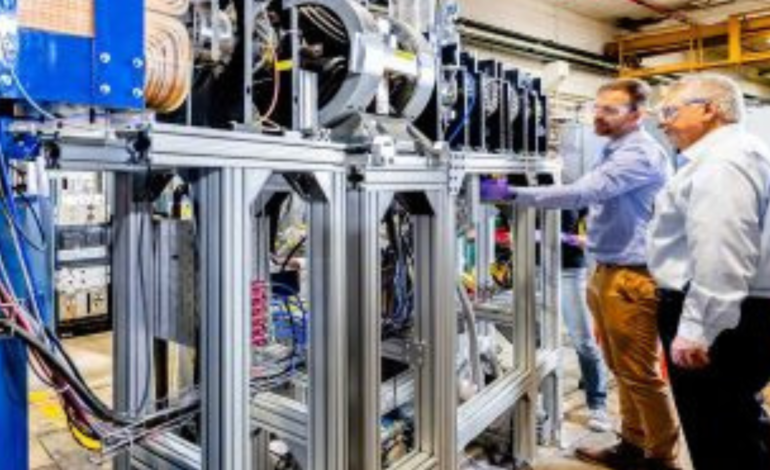
To evaluate one promising material, the team used the Argonne Tandem Linac Accelerator System (ATLAS), a U.S. Department of Energy Office of Science user facility.
Using the ATLAS Materials Irradiation Station, researchers bombarded the material with heavy ions to simulate radiation damage associated with reactor service.
ACCELERATED IRRADIATION TESTING
According to Argonne, the irradiation station was able to produce material degradation in about one day comparable to approximately one year of reactor exposure, without creating the same long-lasting radioactivity associated with reactor irradiation.
The team used the test as a demonstration case for the broader materials-optimization framework. According to the researchers, the candidate material was able to withstand the simulated reactor conditions while maintaining corrosion resistance in the experiment.
That does not mean the material is already a fully qualified replacement for nickel-based alloys. Nuclear qualification is a much broader process, and the research team described this work as a demonstration of how the framework can guide future optimization.
IMPORTANT DISTINCTION
Promising test performance is not the same as full nuclear qualification.
The value of the framework is that it may help researchers reach stronger candidate designs faster before they move into the longer and more complex qualification process.
What’s Next for the Research?
At the time of the original report, the Argonne team planned to pursue a patent related to the new coating material and seek additional funding to study its properties further.
The project had been supported through Argonne’s Laboratory Directed Research and Development program.
More broadly, the framework is intended to be adaptable to different coating systems rather than being limited to a single material. That could allow future researchers to explore multiple compositions, coating architectures, and material combinations more systematically.
WHY THIS RESEARCH MATTERS
Materials discovery is part of the nuclear energy challenge.
Advanced reactor concepts depend on materials capable of surviving demanding service conditions for long periods. Faster methods for identifying and optimizing those materials could help reduce development time, manage critical-material dependence, and support future reactor technologies.
Common Questions About Nuclear Reactor Materials and Corrosion
Quick answers based on the Argonne research described in this article.
Why are nickel-based alloys used in nuclear reactors?
Nickel-based alloys can offer strength, corrosion resistance, and performance in harsh high-temperature environments, which makes them useful for certain advanced nuclear applications.
Why does Argonne want alternatives to nickel?
The research is partly motivated by cost, critical-material supply concerns, and the desire to reduce dependence on nickel while retaining the material performance required for advanced reactor environments.
Why is corrosion resistance important in a nuclear reactor?
Reactor materials may be exposed to high temperatures, radiation, chemical environments, and mechanical stress. Corrosion could degrade material performance, so candidate materials and coatings must be evaluated for resistance under relevant service conditions.
How can modeling speed up materials development?
Multiphysics modeling can help researchers predict how changes in composition, coating architecture, or thickness may affect performance before every variation is physically fabricated and tested.
Has Argonne already found a replacement for nickel alloys?
The reported work demonstrated a promising candidate material and a broader optimization framework, but the source does not state that a fully qualified universal replacement for nickel-based alloys has been established.
SOURCE & ORIGINAL PUBLICATION
Source: Argonne National Laboratory.
This article, by Ben DuBose, first appeared on MaterialsPerformance.com on October 1, 2024. Reprinted with permission.
EXPLORE MATERIALS PERFORMANCE
More Research on Corrosion and Materials Protection
Explore technical reporting, research, case studies, and industry developments covering corrosion, coatings, materials performance, and asset integrity.

Have photos or videos from the field? Submit them to AMPP →